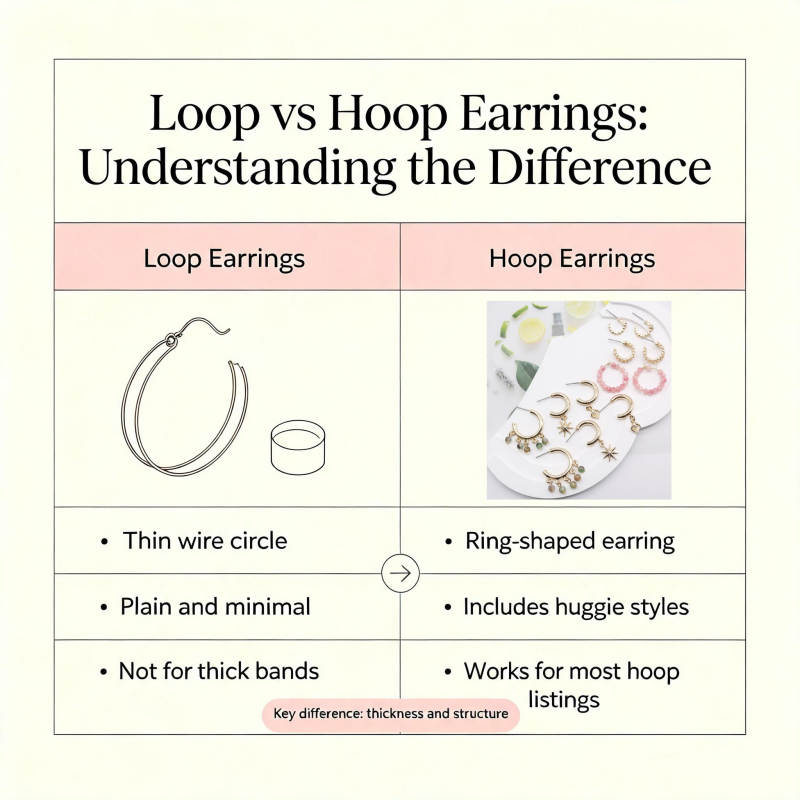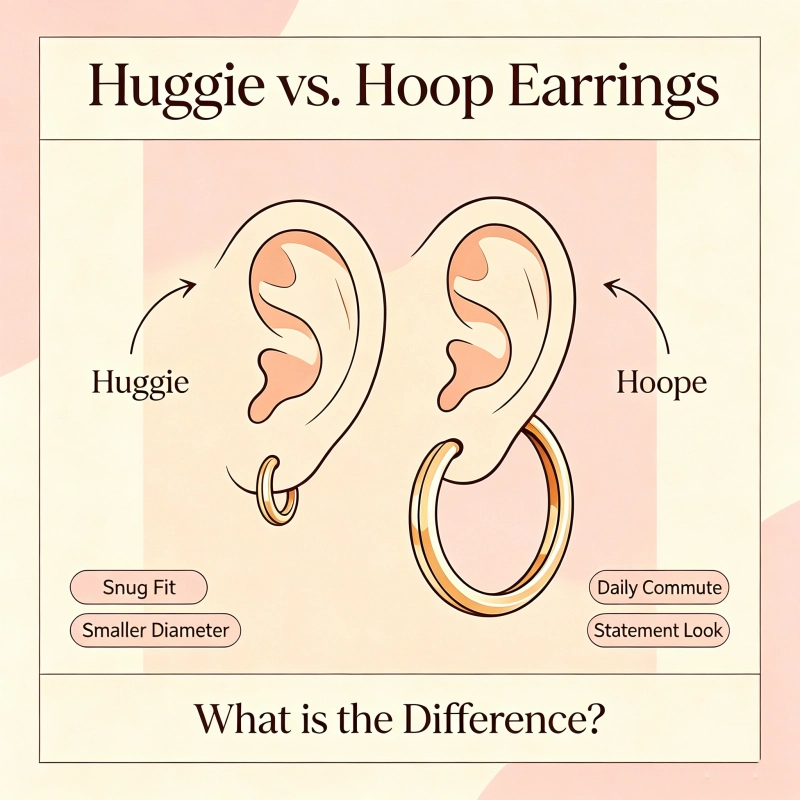
Huggie and hoop earrings may look similar at first glance, but they are not exactly the same. The main differences come down to size, fit, movement, style, and how closely the earring sits around the earlobe.
In simple terms, huggie earrings are a small, close-fitting style of hoop earring, while traditional hoop earrings usually have a larger diameter and extend farther away from the ear. Huggies are often chosen for their subtle, everyday look, while hoops can range from delicate small designs to bold statement pieces.
If you are deciding between huggies and hoops—or looking for the right style for a jewelry collection—understanding these differences can make the choice much easier.
Quick Answer: Huggie vs. Hoop Earrings
The easiest way to understand the difference is to think of “hoop” as a broad category and “huggie” as a specific style within that category.
Huggie earrings are typically small and designed to sit closely around the earlobe. Their compact shape gives them a discreet and minimalist appearance. Hoop earrings, on the other hand, come in a much wider range of sizes and designs and generally create more visible space between the earlobe and the outer edge of the hoop.
| Feature | Huggie Earrings | Hoop Earrings |
|---|---|---|
| Typical size | Small and compact | Small to oversized |
| Fit | Sits closely around the earlobe | Usually extends farther from the ear |
| Appearance | Subtle and minimalist | From delicate to bold |
| Movement | Usually limited | More movement, especially in larger sizes |
| Everyday wear | Excellent for everyday styling | Depends on size and weight |
| Styling | Great for stacking and multiple piercings | Great for classic and statement looks |
| Design variety | Usually compact designs | Extremely broad range of sizes and styles |
So, if you want a simple everyday earring that stays close to the ear, huggies may be the better choice. If you want more size, movement, or visual impact, hoops offer more possibilities.
What Are Huggie Earrings?
Huggie earrings are small hoop earrings designed to sit closely around or “hug” the earlobe. The name comes from their close-fitting shape.
Unlike large or traditional hoops, huggies usually have a compact diameter and a relatively close profile. Many designs use hinged or click-in closures, allowing the earring to wrap neatly around the lower part of the ear.
Their small size makes huggies particularly popular for everyday jewelry. They can create a polished look without becoming the main focus of an outfit.
Huggies are also commonly used in ear stacks. Because they take up relatively little visual space, they can be combined with studs, other huggies, or small hoops to create a layered look.
How Do Huggie Earrings Fit?
The defining characteristic of a huggie is its close fit.
A well-fitted huggie sits near the earlobe rather than hanging several millimeters or centimeters away from it. Depending on the wearer's ear anatomy and the design of the earring, the fit can range from gently following the contour of the lobe to almost completely surrounding it.
This close-fitting construction is one reason huggies are often associated with minimalist and everyday jewelry.
Why Are They Called Huggies?
The term “huggie” refers to the way the earring appears to hug the earlobe.
It is not simply a reference to the material or closure. Instead, it describes the overall design concept: a small hoop that sits close to the ear.
This is also why the distinction between huggies and other small hoops can sometimes be unclear. There is no single universal size that officially defines a huggie. The term generally describes a compact, close-fitting style rather than one exact diameter.
What Are Hoop Earrings?
Hoop earrings are earrings designed around a circular, semicircular, oval, or similar open-loop shape. They are one of the most recognizable and versatile earring styles and are available in a huge variety of sizes, materials, finishes, and designs.
A hoop can be extremely small and delicate or large enough to become the focal point of an outfit.
Traditional hoops generally create more visible space between the earlobe and the outer edge of the earring. Larger hoops also tend to have more movement as the wearer walks or turns their head.
Because “hoop” describes such a broad category, there is significant variation in appearance and wearability.
Small hoops may look similar to huggies, while medium and oversized hoops usually have a much more distinctive silhouette.
Huggie vs. Hoop Earrings: Key Differences
Although both styles are based on the hoop concept, several details distinguish huggies from other hoop earrings.
1. Size
Size is usually the easiest difference to notice.
Huggies are generally small and compact. Their purpose is to sit close to the earlobe, so they do not usually extend far beyond the ear.
Hoops are available in a much broader range of diameters. They can be tiny, medium-sized, large, or oversized.
However, size alone does not always determine whether an earring is a huggie. A small hoop may visually resemble a huggie but have a different fit or construction.
The key is the combination of size and how closely the earring sits around the ear.
2. Fit
Fit is one of the most important distinctions.
Huggies are designed to sit closely around the earlobe. This creates a neat, compact appearance and minimizes the open space typically associated with hoop earrings.
Traditional hoops generally extend farther away from the ear, creating a more visible circular or curved silhouette.
For jewelry designers, this difference in fit can have a significant impact on the final appearance of a collection. A few millimeters can change an earring from a subtle everyday design into a more noticeable fashion piece.
3. Comfort
Huggies are often considered comfortable for everyday wear because of their compact construction and close fit.
However, comfort does not depend on size alone. Other factors include:
Earring weight
Metal or base material
Thickness
Closure design
Post or hinge construction
Surface finish
Individual ear anatomy
A lightweight hoop can be extremely comfortable, while a poorly designed or heavy huggie may not be.
For this reason, when developing earrings for retail collections, designers should consider the complete construction rather than focusing only on diameter.
4. Style
Huggies are strongly associated with minimalist, understated, and everyday styling.
They work particularly well with:
Minimalist outfits
Office looks
Casual everyday wear
Ear stacking
Multiple-piercing combinations
Layered jewelry
Hoops offer a much wider stylistic range.
A thin small hoop can create a delicate appearance, while a large gold-tone hoop can become the focal point of an entire outfit. Decorative hoops can also incorporate charms, stones, textures, beads, enamel, unusual shapes, or mixed materials.
In other words, huggies tend to emphasize subtlety, while hoops provide more room for visual expression.
5. Movement
Because huggies sit close to the earlobe, they generally have limited movement.
This contributes to their compact and clean appearance.
Larger hoops, by contrast, can move more freely. This movement can add visual interest and make the earrings more noticeable.
For fashion jewelry collections, movement can therefore become part of the design language. A static, close-fitting huggie communicates something very different from a large, swinging hoop.
6. Everyday Wear
Huggies are particularly well suited to everyday jewelry collections because their small profile can work across many different occasions.
They can transition from casual daytime outfits to workwear and evening looks without requiring a significant change in styling.
Hoops can also be suitable for everyday wear, particularly when they are lightweight and moderately sized. Larger or heavier hoops may be more appropriate for specific fashion occasions depending on the design and wearer.
Are Huggie Earrings Considered Hoops?
Yes. Huggie earrings can generally be considered a type of hoop earring.
However, “hoop” is a broad category, while “huggie” refers to a particular close-fitting style.
Think of it this way:
Hoop = the broader earring category
Huggie = a small, close-fitting hoop style
This means that every huggie can generally be described as a hoop, but not every hoop is a huggie.
This distinction is especially useful when shopping for jewelry or developing product collections. Two earrings may both have a circular shape, but their intended fit, proportions, and styling can be very different.
Huggie vs. Hoop Earrings: Which Should You Choose?
The right choice depends on the look, occasion, and overall styling you want.
Choose Huggies If You Want:
A minimalist everyday look
Huggies provide a clean and understated appearance that works well with a wide range of outfits.
A close-fitting design
If you prefer earrings that stay close to the earlobe rather than extending outward, huggies are a natural choice.
An easy option for ear stacking
Their compact profile makes huggies easy to combine with studs and other earrings.
A subtle fashion statement
Huggies can add polish to an outfit without dominating the overall look.
A versatile basic earring
For jewelry wardrobes and commercial collections, simple huggies can function as reliable everyday pieces.
Choose Hoops If You Want:
More visual impact
Larger hoops naturally attract more attention and can become a key element of an outfit.
More size options
Hoops are available in a huge range of diameters, giving designers and consumers more freedom to choose a specific visual effect.
More movement
If you like earrings that move as you walk, medium and larger hoops can create a dynamic look.
A classic statement
Hoop earrings have remained a recognizable fashion jewelry style and can be adapted to many different trends.
More design possibilities
Hoops can be decorated with charms, textures, stones, beads, enamel, mixed materials, and different shapes.
Can You Wear Huggies and Hoops Together?
Absolutely.
Huggies and hoops can work particularly well together when creating a layered ear look.
For example, a small huggie can be worn in one piercing while a larger hoop is placed in another. This creates a contrast between the close-fitting silhouette of the huggie and the more open shape of the larger hoop.
For multiple-piercing styling, designers can combine different:
Diameters
Thicknesses
Finishes
Textures
Shapes
Decorative elements
The result can range from subtle and minimalist to bold and fashion-forward.
This combination also creates opportunities for jewelry brands to develop coordinated collections rather than selling individual earring designs in isolation.
Huggies vs. Small Hoops: Are They the Same?
Not necessarily.
A small hoop can look very similar to a huggie, but the terms are not always interchangeable.
The main distinction is the intended fit.
A huggie is designed to sit closely around the earlobe, while a small hoop may still leave more space between the earring and the ear.
There is also no universally accepted measurement that separates every “small hoop” from every “huggie.” Different jewelry brands may use different product naming conventions.
For shoppers, it is therefore more useful to look at the actual diameter, internal dimensions, thickness, closure, and fit rather than relying only on the product name.
What Size Is Considered a Huggie?
There is no universal size that officially defines a huggie earring.
The term generally refers to a small, close-fitting hoop rather than one exact diameter.
When choosing a huggie, the most important measurement is often the internal diameter rather than the total outside diameter. This helps determine how the earring will fit around the wearer's earlobe.
For jewelry brands, providing clear product dimensions is particularly important because ear anatomy varies from person to person.
Instead of describing a design only as a “huggie,” product specifications can include measurements such as:
Outer diameter
Inner diameter
Thickness
Weight
Closure dimensions
This makes it easier for customers to understand the actual fit before purchasing.
Which Is Better for Everyday Wear: Huggies or Hoops?
For a subtle, close-fitting everyday style, huggies are often the easier choice.
Their compact profile works well with casual outfits, professional clothing, layered jewelry, and multiple piercings.
However, lightweight hoops can also be excellent everyday earrings. The best option depends on the desired visual effect and the specific design.
For brands developing everyday jewelry collections, offering both styles can be useful. Huggies can serve as minimalist essentials, while small and medium hoops can provide additional styling options.
Are Huggies Good for Multiple Ear Piercings?
Huggies are often a popular choice for multiple-piercing looks because of their compact size.
A small huggie can be paired with a stud, another huggie, or a small hoop without making the overall ear stack appear too crowded.
The exact design should still be selected according to the location of the piercing, the anatomy of the ear, and the dimensions of the individual earring.
For jewelry collections targeting younger consumers and fashion-conscious shoppers, huggies can therefore be particularly useful as part of coordinated ear-stack collections.
How Jewelry Brands Can Use Huggies and Hoops in a Collection
For retailers and jewelry brands, the difference between huggies and hoops is more than a matter of terminology. It can also help define product architecture.
A balanced earring collection might include:
Huggies: Everyday essentials and stacking pieces
Small hoops: Minimalist fashion styles
Medium hoops: Versatile statement pieces
Large hoops: High-impact fashion designs
Decorative hoops: Trend-driven and seasonal products
This approach allows a brand to serve different consumer preferences while maintaining a consistent design language.
It can also create opportunities for coordinated collections, such as matching finishes, textures, charms, or decorative details across multiple hoop sizes.
Custom Huggie and Hoop Earrings for Jewelry Brands
For retailers looking to develop their own huggie or hoop collections, product differentiation often comes from the details.
At Qingdao OKA Arts and Crafts Co., Ltd. (OKA Accessories), we specialize in custom jewelry and fashion accessories for global retailers and brands.
Our team combines more than 15 years of industry experience with dedicated design and production capabilities. We have worked with Korean factories and British suppliers and currently support customers across more than 50 countries.
Our design capabilities include a London design center with extensive experience serving mainstream retailers in Europe and the United States, as well as a Qingdao design team closely connected to local raw material markets. By combining CAD development with manual design, our designers can respond quickly to changing fashion trends and develop collections tailored to different brand aesthetics.
For huggie and hoop earrings, customization can include:
Custom shapes and proportions
Different hoop diameters and thicknesses
Custom closures
Textures and surface treatments
Charms and decorative elements
Plating and finishes
Material combinations
Brand-specific design details
Our designers and artisans work closely with customers from concept development through sample completion, with attention to both aesthetics and production feasibility.
Production and Quality Capabilities
OKA Accessories operates its own mold workshop with five technicians and an in-house casting room, supporting efficient development and production.
Our monthly production capacity exceeds 1,000 samples, while annual production capacity is approximately 5–7 million pieces.
After sample confirmation, our standard delivery time is approximately 5–6 weeks, with an on-time delivery rate of 97%.
Quality control is integrated throughout the production process. We conduct 100% full inspection, with management signature release before products are shipped. Our laboratory testing pass rate is approximately 98%, with testing designed to meet European and American market requirements.
Our minimum order quantity starts at 200 pieces, making custom development accessible for a wide range of fashion jewelry projects.
With offices in Qingdao and Yiwu and a design presence in London, OKA Accessories combines access to China's jewelry supply chain with an understanding of international fashion trends.
We currently serve customers in more than 50 countries and have worked with internationally recognized retailers and brands, including Pull&Bear, Tally Weijl, and Urban Outfitters.
Frequently Asked Questions About Huggie and Hoop Earrings
Are huggie earrings the same as hoop earrings?
Not exactly. Huggies are generally considered a type of hoop earring, but they are distinguished by their small size and close-fitting design.
Are huggies smaller than hoops?
Huggies are typically smaller than traditional or statement hoops, but there is no universal size standard. Some small hoops may overlap with the size range of huggies.
Are huggies more comfortable than hoops?
Huggies are often comfortable for everyday wear because they sit close to the ear and are usually compact. However, comfort depends on the earring's weight, materials, thickness, closure, and individual ear anatomy.
Are huggies good for everyday wear?
Yes. Their compact and understated design makes huggies a popular choice for everyday jewelry.
Can you wear huggies and hoops together?
Yes. Combining huggies with larger hoops or other earrings can create a layered and balanced ear-stack look.
What is the difference between huggies and small hoops?
The main difference is usually the fit. Huggies are designed to sit closely around the earlobe, while small hoops may leave more space between the earring and the ear.
What size is a huggie earring?
There is no single official size that defines a huggie. The term generally describes a small, close-fitting hoop. When choosing or designing one, internal diameter and overall fit are important considerations.
Final Thoughts: Huggies or Hoops?
The difference between huggie and hoop earrings is ultimately about more than size.
Huggies are compact, close-fitting, understated, and especially suitable for everyday wear and ear stacking. Hoops cover a much broader range of sizes and styles, from delicate small hoops to large statement designs.
If you are choosing earrings for personal wear, consider the fit, weight, styling preferences, and occasion.
If you are developing a jewelry collection, consider how different hoop sizes and huggie designs can work together to create a broader product assortment.
For brands looking for a custom jewelry manufacturing partner, OKA Accessories combines fashion-focused design, flexible customization, production capacity, and quality control to help turn jewelry concepts into commercially viable collections. Feel free to contact us to discuss your ideas.