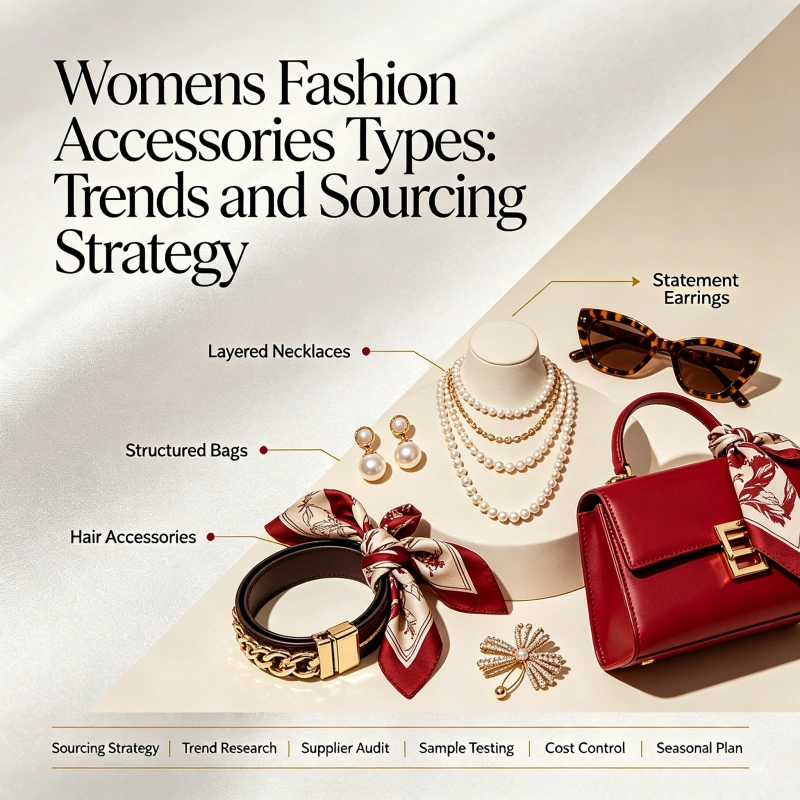
In 2026, women’s fashion accessories are no longer just decorative add-ons. They are the primary drivers of outfit identity, retail profit margins, and supply chain agility. For brand owners and buyers, understanding accessory types is now a commercial necessity. This guide breaks down categories by business function, integrates real sourcing data from industry veterans like Qingdao OKA Arts and Crafts Co., Ltd (OKA Accessories), and provides actionable tables for quick decision-making. We avoid fluff and focus on what actually drives sales and customer loyalty in the current market landscape.
Core Accessory Categories by Commercial Function
Modern retail merchandising prioritizes user intent over encyclopedic lists. Categorizing by commercial function aligns with how consumers shop and how successful brands plan assortments.
Anchor Pieces: High-Value Identity Drivers
These items define a brand’s aesthetic and command premium pricing. They rely on material quality and timeless design rather than fleeting trends.
Statement Necklaces: Sculptural metal and layered pearls dominate. Require minimum 0.5-micron gold vermeil plating to prevent tarnishing.
Cuff Bracelets: Textured finishes (hammered, matte) outperform high-polish styles in e-commerce photography. Need specialized casting for lightweight durability.
Oversized Earrings: Lightweight hollow metals and asymmetrical designs lead volume. CAD precision is critical to balance size and wearability.
Volume Drivers: Trend-Cycle Accelerators
Low-cost, high-turnover items that capture micro-trends and drive social media engagement. Essential for fast-fashion and DTC brands.
Hair Accessories: Claw clips, silk scrunchies, and metal pins are top performers. Premium acetate and fabric-wrapped options reduce returns vs. cheap plastic.
Layering Chains: Sold in sets or modular components. Clasp quality and tarnish resistance are non-negotiable for skin-contact items.
Seasonal/Novelty Items: Holiday and festival gear requiring ultra-short lead times. Manufacturer sample speed determines trend capture success.
Functional Hybrids: Utility Meets Aesthetics
2026 consumers demand dual-purpose accessories. Purely decorative items face stiffer competition than those solving practical problems.
Tech-Integrated Jewelry: Smart rings and NFC bracelets require traditional jewelry housing expertise alongside tech components.
Convertible Pieces: Multi-wear necklaces and reversible pendants appeal to sustainability-focused buyers. Higher manufacturing complexity due to moving parts.
Bag Charms & Hardware: Customization for existing handbags bridges leather goods and jewelry. Attachment loop strength is a key quality checkpoint.
Quick-Reference Material & Sourcing Matrix
This table consolidates critical procurement data for immediate use. All metrics reflect 2026 industry standards and OKA Accessories’ verified production capabilities.
| Accessory Type | Primary Materials (2026) | Target Retail Price (USD) | Key Quality Risk | Sample Lead Time | Bulk Lead Time | Realistic MOQ |
|---|---|---|---|---|---|---|
| Statement Earrings | Brass/Zinc Alloy + Gold Vermeil, Resin | $28 - $85 | Weight imbalance, edge plating wear | 7-10 days | 5-6 weeks | 200-300 pcs/style |
| Hair Claws/Clips | Premium Acetate, Metal Alloy, Silk | $12 - $35 | Hinge failure, sharp teeth, color fade | 5-7 days | 4-5 weeks | 300-500 pcs/color |
| Layering Necklaces | Stainless Steel, Sterling Silver, Plated Brass | $18 - $65 | Chain tangling, clasp breakage, tarnish | 7-10 days | 5-6 weeks | 200 pcs/length |
| Cuff Bracelets | Solid Brass, Aluminum, Leather/Metal Hybrid | $35 - $95 | Cracking during adjustment, sizing variance | 10-14 days | 6 weeks | 150-200 pcs/size |
| Bag Charms | Mixed Media, Enamel, Fabric | $15 - $45 | Loop weakness, enamel chip, color bleed | 7-10 days | 5-6 weeks | 200-300 pcs/design |
| Fashion Rings | Stainless Steel, Plated Alloy, Natural Stone | $12 - $40 | Sizing inaccuracy, stone loss, allergies | 5-7 days | 4-5 weeks | 200 pcs/size run |
| Headbands/Wraps | Silk, Velvet, Technical Knit, Wire-Core | $20 - $55 | Elastic fatigue, fabric slippage, wire poke | 7-10 days | 5-6 weeks | 200-300 pcs/fabric |
Sourcing Note: Always buffer 1-2 weeks beyond stated lead times for QC and international shipping. OKA’s 97% on-time delivery rate includes this buffer; verify if other suppliers do the same.
Competitive Positioning Framework
The 2026 accessory market has three distinct competitive arenas. Winning requires targeted strategies, not generic best practices.
Arena 1: Responsive Quality vs. Ultra-Fast Fashion
Ultra-fast fashion wins on price but loses on retention. Mid-market brands win by matching trend speed while delivering verifiable quality.
Competitor Weakness: Disposable accessories fail after 2-3 wears, eroding trust and increasing return rates.
Your Edge: Highlight specific quality metrics (plating thickness, lab test pass rates). OKA’s 98% EU/US standard compliance justifies 30-50% price premiums.
Action: Create comparison content showing cross-sections of plating layers and stress-test videos. Make quality visible.
Arena 2: Proprietary Design vs. Generic White-Label
Retailers and platforms penalize duplicate product listings. Custom SKUs earn customer loyalty and platform preference as unique offerings.
Competitor Weakness: Sellers using identical supplier images compete only on ad spend, which is unsustainable.
Your Edge: Leverage manufacturer design collaboration. OKA’s London Design Center + Qingdao raw material integration enables exclusive, trend-forward SKUs.
Action: Invest in small-batch custom development (200-piece MOQ). Document your design process to build brand authority.
Arena 3: Verifiable Ethics vs. Greenwashing
Vague sustainability claims are losing effectiveness. Consumers and regulators demand granular transparency.
Competitor Weakness: Unsubstantiated "eco-friendly" labels face reputational risk and regulatory scrutiny.
Your Edge: Provide third-party test reports, recycled metal percentages, and labor audit documentation. OKA’s lab certification and full inspection protocols offer concrete proof.
Action: Embed compliance docs directly into product pages. Explain material choices for both aesthetics and ethics.
Sourcing Decision Checklist
Use this checklist when evaluating manufacturers or planning production runs. Based on OKA’s 15+ years serving global retailers.
✅ Pre-Sourcing Validation
Does the supplier offer integrated design-to-production workflow? (Avoid middlemen)
Is sample turnaround ≤10 business days for standard categories?
Do they provide salt spray, nickel release, and adhesion test data—not just “gold plated” claims?
Can they handle both high-volume basics and low-MOQ custom pieces under one roof?
Do they have backup plating facilities and redundant raw material sources?
✅ Production Quality Gates
100% full inspection (not AQL sampling) for all fashion accessories
Management sign-off required before shipment release
Lab test pass rate ≥98% against target market standards (EU REACH / US CPSIA)
Defect categorization report included with every shipment
Hypoallergenic certification for all skin-contact components
✅ Post-Delivery Metrics to Track
Return rate by SKU and defect type
Customer review sentiment analysis for quality mentions
Sell-through rate vs. initial forecast
Reorder frequency and timing accuracy
Supplier corrective action response time
Material Science Essentials for Buyers
Understanding materials prevents costly quality failures and supports authentic marketing claims.
Plating Standards That Survive Real Wear
Gold vermeil (sterling silver base + 2.5μm gold) remains premium. PVD-coated stainless steel offers comparable durability at lower cost. For brass/zinc alloys, nickel-free barrier layers (palladium/tin) are mandatory to prevent allergic reactions and base metal migration.
| Plating Type | Base Metal | Gold Thickness | Durability | Best For | Cost Tier |
|---|---|---|---|---|---|
| Gold Vermeil | Sterling Silver | ≥2.5 microns | 2+ years with care | Premium anchor pieces | High |
| PVD Gold | Stainless Steel | N/A (atomic bond) | 3-5 years daily wear | Everyday layering chains | Medium |
| Electroplated | Brass/Zinc Alloy | 0.3-0.5 microns + barrier | 6-12 months | Trend-driven volume items | Low-Medium |
| Flash Plated | Base Metal | <0.1 microns | Weeks to months | Disposable novelty (avoid) | Very Low |
Sustainable Materials: Performance Parity Required
Recycled brass/silver are baseline. Bio-acetate and ocean-bound plastics must match traditional material performance in gloss, flexibility, and aging. Always verify through chain-of-custody documentation, not supplier assertions. OKA’s Qingdao raw market access enables real-time material origin verification.
Hypoallergenic Compliance as Table Stakes
Nickel sensitivity affects 10-20% of people. In 2026, hypoallergenic is a legal requirement, not a niche feature. Ensure all posts, clasps, and skin-contact surfaces meet REACH/CPSIA. Titanium/surgical steel posts preferred for earrings; nickel-free plating mandatory for alloys.
Content Optimization Tactics for Accessory Brands
Successful product and category pages follow these principles to engage customers and build trust.
Answer Specific Long-Tail Queries
❌ Don’t write: “Types of Earrings”
✅ Do write: “Lightweight Statement Earrings for Sensitive Ears: Materials & Styling Guide”
Specificity matches shopper intent and signals expertise to customers.
Embed Original Data Tables
Generic descriptions cannot replicate proprietary sourcing matrices, quality benchmarks, or lead time comparisons. Tables earn trust and engagement because they provide unique, scannable value. Update quarterly to maintain relevance.
Demonstrate First-Hand Experience
Reference real production challenges, supplier evaluation criteria, and client outcomes. Mention specific manufacturing partners (e.g., OKA’s London design center, 100% inspection protocol). Experience is the strongest trust signal in 2026.
Structure for Dual Reading Modes
Scanners: Clear headings, bullet points, bolded key terms, summary tables
Deep Readers: Detailed explanations, case studies, technical specifications, sourcing checklists
Both behaviors signal content quality. Avoid walls of text; break complex topics into digestible subsections.
Trend Forecast Integration: Aligning Product Dev with Consumer Demand
2026 accessory trends move faster than traditional fashion cycles. Align product development with emerging search patterns.
Current High-Growth Search Terms (Q3 2026)
“Tarnish-free gold jewelry” (+180% YoY)
“Adjustable cuff bracelet no gap” (+145% YoY)
“Silk scrunchie hair tie no crease” (+210% YoY)
“Convertible necklace bracelet set” (+165% YoY)
“Hypoallergenic statement earrings lightweight” (+190% YoY)
How to Validate Trends Before Production
Cross-reference Google Trends with TikTok/Instagram hashtag velocity
Check Amazon/Etsy bestseller lists for validation of commercial intent
Request trend reports from manufacturer design teams (OKA’s London center provides quarterly forecasts to partners)
Test with 200-piece MOQ before scaling to full production
Monitor early sales velocity and return reasons to confirm trend longevity
Warning: Micro-trends can collapse in 4-6 weeks. Never commit >30% of inventory to unvalidated trends. Use flexible MOQ partners to test safely.
Packaging & Presentation: The Unboxing Experience as Brand Builder
In 2026, packaging is part of the product. It drives repeat purchases, social sharing, and perceived value.
Sustainable Packaging Standards
Plastic-Free: Recycled paper, FSC-certified cardboard, compostable mailers
Reusable: Cotton pouches, rigid boxes designed for storage, fabric wraps
Minimalist: Reduce material use without sacrificing protection; eliminate unnecessary inserts
Quality Protection During Transit
Accessories are fragile. Packaging must prevent tarnish, scratching, and deformation.
| Accessory Type | Recommended Packaging | Anti-Tarnish Requirement | Drop Test Standard |
|---|---|---|---|
| Statement Earrings | Rigid box + foam insert | Anti-tarnish strip included | 1.2m drop, no damage |
| Hair Clips | Pouch + card backing | Silica gel packet | 1m drop, no hinge damage |
| Necklaces | Box with necklace pad | Anti-tarnich strip + silica | 1.2m drop, no chain tangle |
| Cuffs | Individual cloth bag + box | Anti-tarnish strip | 1m drop, no deformation |
| Bag Charms | Bubble wrap + box | None typically needed | 1.5m drop, no enamel chip |
Brand Consistency Across Touchpoints
Packaging should reflect brand positioning. Premium brands use textured papers and embossing; sustainable brands use unbleached materials and soy ink. OKA Accessories offers custom packaging solutions aligned with brand identity and sustainability goals.
Pricing Strategy: Balancing Margin, Perception, and Competitiveness
Pricing accessories requires balancing cost, perceived value, and market positioning. Use this framework to set prices that convert.
Cost-Plus vs. Value-Based Pricing
Cost-Plus: Safe for volume drivers; ensures margin coverage. Formula: (COGS + Shipping + Duties) x 2.5-3x
Value-Based: Essential for anchor pieces; captures brand equity. Price based on competitor benchmarking and customer willingness-to-pay.
Price Anchoring Techniques
Display higher-priced anchor pieces alongside volume drivers to make mid-tier items appear more reasonable. Bundle complementary items (e.g., necklace + earrings) at a slight discount to increase average order value.
Margin Targets by Category
| Category | Target Gross Margin | Rationale | Price Elasticity |
|---|---|---|---|
| Anchor Pieces | 70-80% | High perceived value, lower volume | Low |
| Volume Drivers | 60-70% | Competitive pricing needed, high turnover | High |
| Functional Hybrids | 65-75% | Utility justifies premium over pure decor | Medium |
| Seasonal/Novelty | 50-60% | Short lifecycle, clearance risk | Very High |
Partner Selection: Why Manufacturing Alignment Matters
Choosing a manufacturer is a strategic decision, not a transactional one. OKA Accessories exemplifies the 2026 partnership model:
Design Intelligence: London Design Center (12 years serving EU/US retailers) + Qingdao raw material market integration = trend relevance with cost efficiency
Production Scale: 5-7M pieces annual capacity, 1000+ monthly samples, own mold workshop (5 technicians) and casting room
Quality Rigor: 100% full inspection, management sign-off, 98% lab test pass rate, EU/US standard compliance
Commercial Flexibility: 200-piece MOQ, 5-6 week bulk lead time post-sample confirmation, 97% on-time delivery
Global Experience: Serving Pull&Bear, Tally Weijl, Urban Outfitters across 50+ countries since 2013
This combination enables brands to move from concept to shelf with confidence, speed, and uncompromising quality—exactly what the 2026 market demands.
Final Takeaways for Immediate Action
Categorize by function, not form. Anchor pieces, volume drivers, and functional hybrids require different sourcing, pricing, and marketing strategies.
Use data tables for decisions. Replace prose-heavy guides with scannable matrices for materials, lead times, MOQs, and quality risks.
Verify quality claims. Demand lab reports, not marketing language. 98% test pass rate and 100% inspection are meaningful benchmarks.
Customize to differentiate. Generic white-label products lose to proprietary designs in both customer loyalty and platform preference. Leverage low-MOQ custom development.
Align content with shopper intent. Answer specific questions, embed original data, demonstrate experience, and structure for both scanners and deep readers.
Choose partners strategically. Manufacturing alignment on design, quality, flexibility, and global experience is a competitive advantage, not a cost center.
Stop guessing and start scaling your accessory brand with confidence. Partner with OKA Accessories today to transform these 2026 market insights into a high-margin, trend-responsive collection that outperforms competitors. Leverage our London design intelligence, 200-piece MOQ flexibility, and 98% quality pass rate to bring exclusive, compliant products to market in weeks, not months. Contact our team now for a free consultation and sample development plan—your next bestseller starts here.