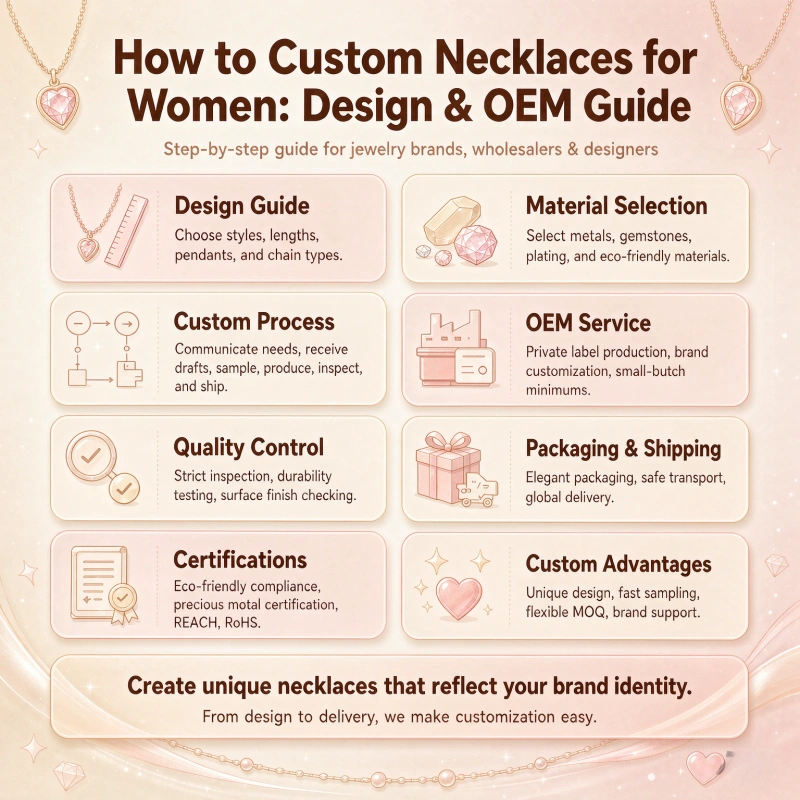
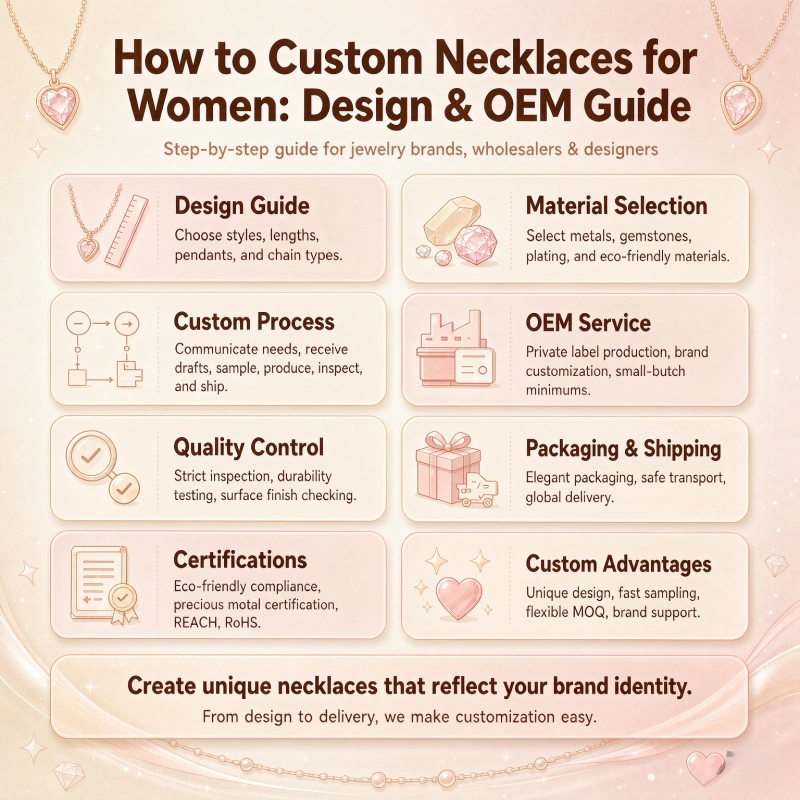
Custom necklaces for women are more than personalized accessories. For jewelry brands, fashion retailers, wholesalers, and private-label businesses, a successful custom necklace combines attractive design, wearable proportions, suitable materials, reliable construction, and consistent production quality.
Whether you want to create a necklace with initials, birthstones, meaningful pendants, layered chains, or a completely original design, the process starts with a clear product concept. You then need to select the right chain, pendant dimensions, materials, plating, and finishing details before moving into sampling and bulk production.
This guide explains how to custom necklaces for women step by step. It covers design ideas, material selection, necklace measurements, manufacturing processes, costs, and supplier evaluation to help you turn an initial idea into a market-ready jewelry collection.
1. Decide What Type of Custom Necklace You Want to Create
Before contacting a jewelry manufacturer, decide how much of the necklace you want to customize. Not every project needs to start from a blank sheet of paper.
There are three common approaches.
| Customization Type | What You Can Change | Best For |
|---|---|---|
| Personalized necklace | Initials, names, dates, engraving, or birthstones | Gift collections and individual customers |
| Modified existing design | Chain, pendant, color, finish, charms, or packaging | Retailers developing differentiated products |
| Fully custom necklace | Structure, pendant shape, dimensions, materials, and construction | Jewelry brands and exclusive collections |
Personalized Necklaces
Personalized necklaces usually start with an existing necklace structure. You add a meaningful detail such as a letter, name, date, zodiac symbol, or birthstone.
Popular options include:
Initial necklaces featuring one or more letters
Nameplate necklaces with custom lettering
Birthstone necklaces for birthdays and family gifts
Engraved disc or bar necklaces
Heart, star, flower, and symbolic pendants
These designs are relatively straightforward when the basic chain and pendant structure already exist.
Modified Existing Designs
If you like an existing necklace but want it to look different, you can customize selected elements rather than developing the entire product from scratch.
For example, a fashion retailer may request a different pendant shape, a longer chain, a gold-tone finish, or a branded jewelry card. This approach can help simplify development while still creating a recognizable product variation.
Explore our pendant necklace collection for examples of pendant-based necklace structures.
Fully Custom Necklaces
A fully custom necklace gives you more control over the product.
You may develop a new chain arrangement, combine multiple decorative components, create a distinctive pendant, or coordinate several necklace styles into one collection.
This route is suitable when you need exclusive designs or want to build a consistent visual identity for your jewelry brand.
2. Choose a Necklace Style for Your Target Customers
The necklace style should match your target customers, retail positioning, and intended wearing occasions.
A design that works for an everyday jewelry collection may not be suitable for a statement or holiday collection.
Here are six popular directions to consider.
Minimalist Chain Necklaces
Minimalist necklaces use simple chain structures and restrained decorative details. They are suitable for everyday collections, gift assortments, and customers who prefer understated accessories.
Common customization options include:
Chain thickness and length
Gold-tone, silver-tone, or other finishes
Small geometric pendants
Initial or symbol charms
Adjustable extension chains
For a simple chain-based design, see our chain necklaces for women.
Pendant Necklaces
Pendant necklaces are among the most flexible formats for customization.
The pendant can become the main visual feature, while the chain provides the supporting structure. You can experiment with different shapes, textures, colors, and decorative components.
Popular pendant concepts include:
Hearts and stars
Flowers and nature-inspired shapes
Geometric and abstract forms
Shell and ocean-inspired motifs
Initials and symbolic charms
When developing a pendant necklace, pay attention to the relationship between pendant size, chain thickness, and total product weight. A large pendant on an extremely delicate chain may look unbalanced and may require a stronger connection structure.
Layered Necklaces
Layered necklaces combine two or more chains or decorative elements into one coordinated design.
You can customize:
The number of necklace layers
The length of each chain
Different chain textures
Pendant placement
Metal colors and decorative details
A useful starting point for a three-layer design is to test chain lengths such as 16, 18, and 20 inches. These are design references, not universal sizing rules. The final spacing should be checked with the actual pendant dimensions and intended neckline.
See our layered necklace designs for additional style inspiration.
Y-Necklaces
Y-necklaces create a vertical visual line through a central drop or pendant.
They work particularly well with V-neck clothing, open necklines, and fashion collections that emphasize decorative details.
When customizing this style, check the drop length, pendant movement, chain connection, and balance between the upper chain and lower section.
Explore our Y-necklace collection for related design directions.
Beaded and Natural-Look Necklaces
Beaded necklaces allow more freedom in color, texture, and component arrangement.
You can combine acrylic beads, glass beads, decorative stones, shells, and metal accents, depending on the intended product positioning and material requirements.
Important development details include bead diameter, hole size, stringing method, spacing, total weight, and clasp construction.
For example, a necklace made with larger decorative beads may require a different construction approach from a lightweight chain necklace, even if both have the same finished length.
Short Necklaces and Chokers
Short necklaces create a closer fit around the neck and can be developed in minimalist, romantic, or statement styles.
The most important factors are finished circumference, adjustment range, clasp design, and the intended position on the wearer.
A short necklace should be tested on a sample rather than approved from a flat product photograph alone.
3. Select Materials, Colors, and Surface Finishes
Material selection affects appearance, product weight, manufacturing cost, durability, and the final selling position.
The best material is not necessarily the most expensive one. It should meet the product's target price, design requirements, market expectations, and applicable testing standards.
Base Materials
Common materials used in fashion necklace development include:
| Material | Typical Characteristics | Development Considerations |
|---|---|---|
| Zinc alloy | Flexible for decorative shapes and casting | Check weight, surface finish, and plating requirements |
| Brass | Suitable for various decorative components | Confirm alloy specification and finishing process |
| Stainless steel | Commonly used for chain and jewelry components | Confirm grade, color treatment, and component compatibility |
| Iron | Used in selected fashion jewelry structures | Review corrosion protection and surface treatment |
| Acrylic | Lightweight and available in different colors and shapes | Check color consistency and scratch resistance |
| Glass beads | Offer decorative color and texture | Check bead quality, drilling, and breakage risk |
Material names alone are not enough for a production order. Ask your manufacturer to specify the actual material used for each component, including the chain, pendant, jump rings, clasp, and decorative elements.
Gold-Tone, Silver-Tone, and Other Finishes
The surface finish strongly influences how a necklace looks.
Common options include:
Gold-tone plating
Silver-tone plating
Rose-gold-tone plating
Antique or oxidized finishes
Polished metal surfaces
Brushed or textured finishes
Enamel and colored decorative coatings
Do not use terms such as "18K gold" to describe a gold-colored plated product unless the actual material and plating specification support that claim.
For production, confirm the base metal, plating process, color reference, coating requirements, and any applicable test standards. Testing requirements depend on the destination market and the product's actual material composition.
For additional information about metal finishing and pricing factors, read our guide to how much gold-plated jewelry costs.
Gemstones, Pearls, and Decorative Components
Decorative components can make a simple necklace more distinctive.
Depending on the design, you may consider:
Glass or acrylic beads
Simulated pearls
Natural stones
Cubic zirconia
Enamel details
Metal charms and decorative connectors
If you use natural stones, define acceptable variations in color, shape, and size. Natural materials do not always look identical from one batch to another.
For commercial production, a reference sample or approved color range can help reduce disagreements during inspection.
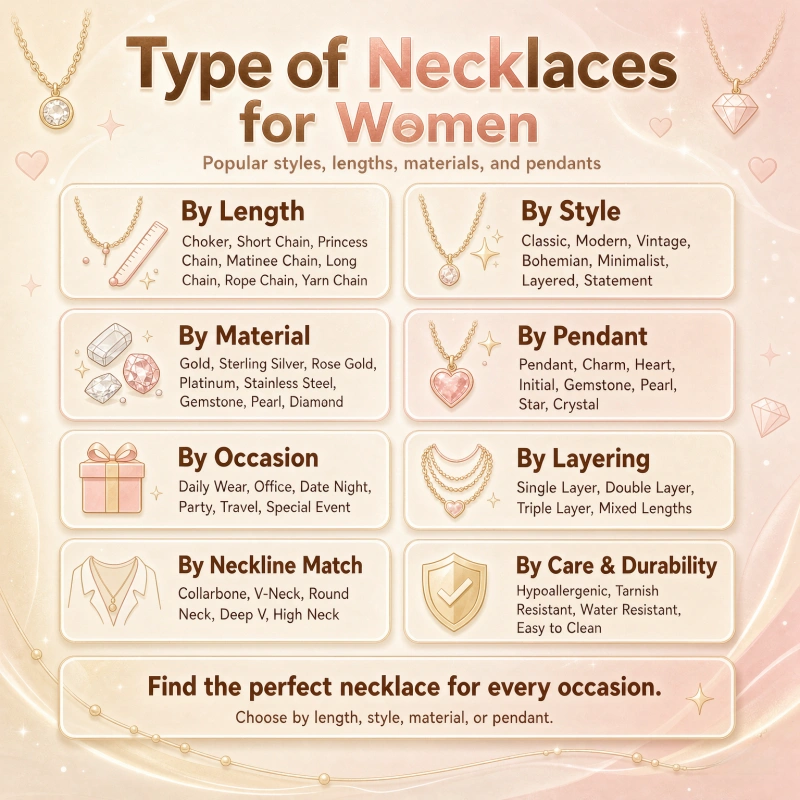
4. Choose the Correct Chain Length and Pendant Dimensions
A necklace may look attractive in a design drawing but feel different when worn. Chain length, pendant dimensions, component weight, and the wearer's neckline all affect the finished appearance.
Common Necklace Length References
The following measurements are useful starting points for women's necklace development.
| Length | Approximate Position | Common Design Direction |
|---|---|---|
| 14 inches | Close to the neck | Choker-style designs |
| 16 inches | Near the collarbone | Short and delicate necklaces |
| 18 inches | Around the collarbone area | Everyday pendant necklaces |
| 20 inches | Below the collarbone | Longer pendants and layering |
| 24 inches | Lower on the chest | Long necklaces and statement designs |
These measurements are general references. Actual placement varies with neck circumference, body proportions, chain construction, and pendant size.
If you are developing a commercial product, specify the finished chain length in inches or centimeters and state whether the measurement includes the clasp and extension chain.
Check Pendant Size Before Sampling
Pendant dimensions should be recorded in millimeters rather than described only as small, medium, or large.
For example, a design brief might specify:
Pendant height: 18 mm
Pendant width: 14 mm
Chain length: 45 cm
Extension chain: 5 cm
Finish: Gold tone
Main component: Zinc alloy
These are illustrative specifications, not a standard size for every necklace.
Also confirm whether pendant measurements include the bail, jump ring, or other connecting components.
Match Chain Strength to Pendant Weight
The chain must be visually and structurally suitable for the pendant.
A heavy pendant attached to a very fine chain can create an unbalanced appearance. The bail, jump ring, and clasp should also be reviewed as part of the complete assembly.
For larger pendants, ask the manufacturer to assess the chain gauge, connection points, and total weight during sample development.
5. Prepare a Clear Custom Necklace Design Brief
One of the most common causes of unnecessary sample revisions is incomplete product information.
A manufacturer may understand the general appearance of your reference image but still need additional information about dimensions, materials, and construction.
Before requesting a quotation, prepare a design brief containing the following details.
| Specification | Information to Provide |
|---|---|
| Product type | Pendant, chain, layered, beaded, Y-necklace, or choker |
| Design reference | Sketch, photograph, CAD drawing, or physical sample |
| Chain | Style, material, thickness, and length |
| Pendant | Shape, dimensions, material, and attachment method |
| Finish | Gold tone, silver tone, rose gold tone, or other finish |
| Decorative details | Stones, pearls, beads, enamel, or charms |
| Clasp | Lobster clasp, spring-ring clasp, or another approved type |
| Branding | Logo engraving, branded tag, or jewelry card |
| Packaging | Individual bag, pouch, box, or retail-ready packaging |
| Order quantity | Estimated quantity per design and color |
| Destination market | Country or region where the product will be sold |
You do not need a professional CAD file to begin a project. A clear reference image and a written description can be enough for an initial feasibility discussion.
However, the more specific your brief is, the easier it becomes to evaluate the design, estimate costs, and reduce misunderstandings during sampling.
6. Understand the Custom Necklace Manufacturing Process
A professional custom necklace project usually moves through several stages. The exact process depends on whether you are modifying an existing design or developing a completely new product.
Step 1: Submit Your Design and Requirements
Send the manufacturer your reference images, sketches, measurements, material preferences, estimated quantity, and target market.
If you are developing several related products, explain the overall collection direction. This helps the design team maintain consistency across different necklaces.
Step 2: Design Review and Technical Evaluation
The manufacturer reviews whether the proposed design can be produced using the selected materials and manufacturing methods.
Typical review points include:
Pendant dimensions and proportions
Chain and clasp compatibility
Component connections
Material availability
Surface finishing requirements
Estimated production complexity
If a design contains small or delicate components, the manufacturer may recommend adjustments before sampling.
Step 3: CAD Development or Mold Preparation
Depending on the product, the manufacturer may prepare CAD drawings, develop a mold, or use existing components.
New casting shapes may require additional tooling or mold development. A design based on standard chain components may need less development work.
Confirm whether any tooling costs apply and whether the mold can be used for future repeat orders.
Step 4: Sample Production
A physical sample allows you to evaluate the actual product rather than relying only on drawings or digital images.
Check:
Overall appearance
Chain length and pendant position
Component dimensions
Color and surface finish
Clasp operation
Weight and wearing comfort
Connection strength
Logo and packaging details, if applicable
A sample should be reviewed under normal lighting and, where possible, worn with the type of clothing for which it is intended.
Step 5: Sample Approval and Specification Confirmation
Before mass production, confirm the approved sample and its key specifications.
Keep a record of the final dimensions, materials, plating color, component details, packaging, and approved reference images.
If a change is made after sample approval, document it clearly. Even a small change in pendant thickness or chain length can affect product weight, appearance, and cost.
Step 6: Bulk Production and Quality Inspection
Once the final sample and order details are approved, the manufacturer can arrange bulk production.
Quality inspection should cover the agreed product specifications, including appearance, dimensions, plating, stone or bead placement, clasp function, and workmanship.
For repeat orders, retaining an approved sample and product specification sheet helps maintain consistency between batches.
7. How Much Does It Cost to Custom Necklaces for Women?
There is no single fixed price for custom necklaces. The final quotation depends on the product structure, material, design complexity, order quantity, finishing process, and packaging requirements.
The main cost factors include:
| Cost Factor | How It Affects the Quotation |
|---|---|
| Base material | Different materials have different purchasing and processing costs |
| Chain structure | Chain type, thickness, and length affect material usage |
| Pendant design | Complex shapes may require additional development or tooling |
| Plating and finishing | Color, process, and specified finish requirements affect cost |
| Decorative components | Stones, beads, pearls, and charms add material and assembly costs |
| Order quantity | Larger quantities may improve production efficiency |
| Packaging | Custom boxes, pouches, cards, and labels add costs |
| Testing requirements | Specific market or customer testing may involve additional fees |
Charmwell Accessories publicly lists fashion jewelry prices starting at approximately US$0.50 per piece. This is a general starting reference for its product range, not a guaranteed quotation for every custom necklace.
The actual price must be calculated from the confirmed design, material specifications, order quantity, and packaging requirements.
How to Request an Accurate Quotation
To receive a useful quotation, provide:
Product reference image or drawing
Chain type and finished length
Pendant dimensions
Material and plating requirements
Estimated quantity per design
Number of colors or variations
Logo and packaging requirements
Destination country
If you are still comparing different designs, ask the manufacturer to quote clearly defined alternatives. For example, compare two pendant materials or two chain structures while keeping the other specifications unchanged.
This makes the cost difference easier to understand.
8. How to Choose a Custom Necklace Manufacturer
Choosing a manufacturer is not only about finding the lowest price. The supplier must be able to understand your design, develop an accurate sample, maintain product consistency, and support your expected order volume.
Here are six points to evaluate.
1. Relevant Necklace Manufacturing Experience
Check whether the supplier has experience with the necklace structures you need.
A factory that mainly produces simple chains may not be the best match for complex beaded necklaces, multi-component pendants, or layered constructions.
Review actual product examples and ask how similar designs are developed.
2. Sampling and Design Development Capability
Ask whether the supplier can work from sketches, reference images, CAD files, or physical samples.
A capable development team should be able to identify potential construction problems before bulk production.
3. Material and Finishing Control
Confirm whether the supplier can clearly identify the base material, surface finish, and decorative components.
If you sell in markets with specific chemical or product requirements, agree on the relevant testing standards and documentation before production.
4. Clear MOQ and Lead Time
MOQ and lead time should be confirmed for the actual product rather than assumed from a general company statement.
A simple necklace using available components may have different production requirements from a fully custom design involving new molds and special finishes.
5. Quality Inspection Procedures
Ask how the supplier checks dimensions, plating, component connections, clasps, and packaging.
It is also useful to understand whether inspection takes place during production and before shipment.
6. OEM, ODM, and Private Label Support
For a growing jewelry brand, a supplier that can support product development and branded packaging may be more useful than one offering only standard wholesale products.
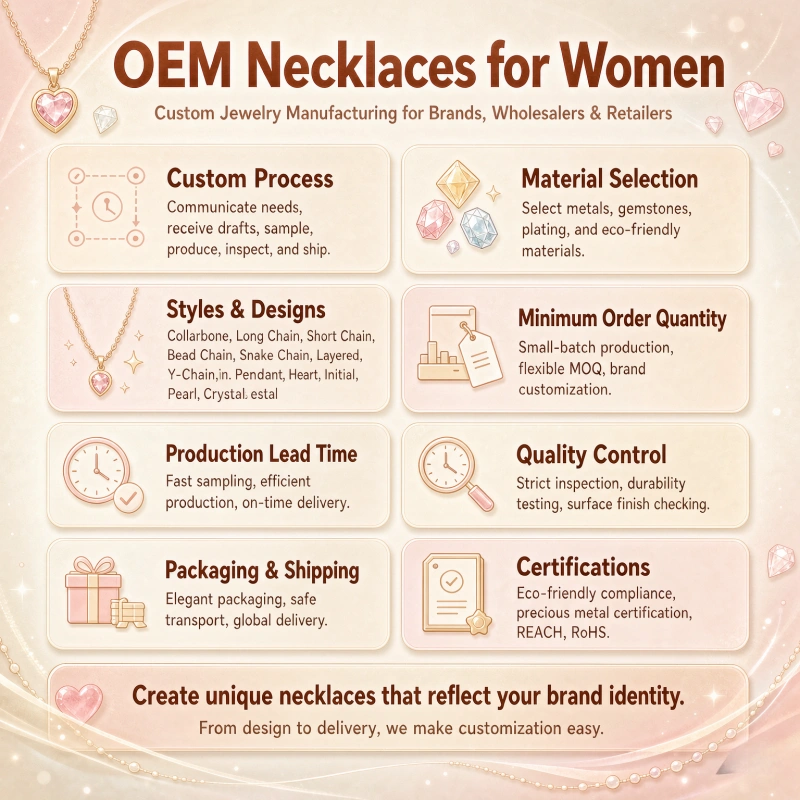
Charmwell Accessories provides OEM and ODM jewelry manufacturing services for brands, retailers, wholesalers, and distributors.
You can also compare suppliers through our guide to custom jewelry manufacturers in China.
9. Custom Necklace OEM and Private Label Services at Charmwell Accessories
Charmwell Accessories is the brand of Qingdao Charmwell Industry & Trading Co., Ltd., a China-based fashion jewelry manufacturer established in 2013.
The company supports OEM, ODM, and private-label jewelry projects for international brands, retailers, wholesalers, and distributors.
Its necklace development services can support projects based on customer drawings, sketches, CAD files, reference photographs, or existing samples.
What Can Be Customized?
Depending on the product and technical requirements, customization may include:
Necklace structure and pendant design
Chain style, length, and components
Material selection and surface finish
Decorative charms and details
Logo engraving and branded tags
Jewelry cards, labels, pouches, and gift boxes
Charmwell's public manufacturing information includes a dedicated sampling team of 10 experienced makers, approximately 1,000 samples developed per month, and annual production capacity of approximately 5–7 million jewelry pieces.
The company's standard MOQ starts at 100 pieces per design, subject to product style, material, and customization requirements. Initial sample development typically takes 7–15 days, while standard bulk production is approximately 5–6 weeks after sample approval. Actual schedules should be confirmed for each project.
For more information about the company, visit our About Charmwell Accessories page.
Develop a Coordinated Women's Necklace Collection
Rather than developing isolated products, brands can create a coordinated collection around a shared design direction.
For example, a summer-inspired collection might include:
A short necklace with a decorative shell pendant
A longer chain necklace with a matching charm
A layered necklace using complementary metal finishes
A beaded necklace with coordinated colors
You can explore our short necklace collection and other necklace styles when planning a product range.
A coordinated collection can help retailers create more consistent product displays and provide customers with additional styling choices.
Private Label Packaging
The product itself is only one part of the retail presentation.
Depending on the project, private-label customization can include:
Logo-printed jewelry cards
Branded labels and product tags
Gift boxes and pouches
Retail-ready packaging
Product inserts and care information
Packaging requirements should be discussed during the quotation and sampling stages so that the final product and its presentation are reviewed together.
10. Common Mistakes to Avoid When Customizing Women's Necklaces
Even an attractive design can create production problems if important details are overlooked.
Mistake 1: Providing Only a Reference Photograph
A photograph may show the overall style but not the exact chain length, pendant thickness, material, or connection method.
Better approach: Add measurements and written specifications to your reference images.
Mistake 2: Ignoring the Relationship Between Chain and Pendant
A pendant may be too heavy for the selected chain, or the bail may not fit the chain correctly.
Better approach: Review the chain, pendant, jump ring, and clasp as one complete construction.
Mistake 3: Choosing Materials Without Confirming Their Specifications
Terms such as gold, silver, natural stone, and hypoallergenic can be interpreted differently.
Better approach: Specify the actual base material, finish, component composition, and any required testing.
Mistake 4: Approving a Sample Without Checking Measurements
A sample may look correct in photographs but differ from the intended size when worn.
Better approach: Measure the physical sample and compare it with the approved product specification.
Mistake 5: Changing Details After Sample Approval
Late changes can affect material purchasing, production scheduling, cost, and product consistency.
Better approach: Confirm all important design details before approving the final sample and starting bulk production.
Mistake 6: Forgetting Packaging and Branding
A well-designed necklace can lose its intended retail presentation if the jewelry card, label, or box is not coordinated with the product.
Better approach: Include packaging and branding requirements in the initial project brief.
11. Custom Necklaces for Women: Frequently Asked Questions
How do I start designing a custom necklace?
Start with a clear concept. Decide the necklace style, target customer, chain length, pendant shape, materials, and preferred finish. Then prepare reference images or a sketch with approximate dimensions and send the information to a jewelry manufacturer for technical review and sampling.
What can I customize on a women's necklace?
You can customize the chain, pendant, length, materials, plating color, decorative stones, charms, clasp, logo, and packaging. The available options depend on the design and manufacturing process.
Can I customize a necklace using only a picture?
Yes. A reference photograph can be used to begin a development discussion. However, you should provide additional measurements, material preferences, and construction details before approving the final sample.
What is the difference between OEM and ODM necklaces?
OEM manufacturing generally follows the buyer's approved design and specifications. ODM development starts from the buyer's idea or reference and includes more design and product-development support. Both approaches can be combined with private-label branding.
What is the MOQ for custom women's necklaces?
MOQ depends on the design, materials, components, and production process. Charmwell Accessories' standard MOQ starts at 100 pieces per design, subject to project requirements. Confirm the actual MOQ for your selected necklace before placing an order.
How long does it take to develop a custom necklace sample?
Charmwell Accessories' typical initial sample development time is approximately 7–15 days. More complex designs, new molds, special materials, and additional revisions may require more time.
How long does bulk production take?
The company's standard production lead time is approximately 5–6 weeks after sample approval. The final schedule depends on order quantity, design complexity, material availability, and production planning.
Can I add my own logo to custom necklaces?
Depending on the design, branding options may include logo engraving, branded tags, jewelry cards, labels, pouches, and gift boxes. The manufacturer should confirm the most suitable method for each product.
How do I make sure the necklaces are consistent in bulk production?
Approve a physical sample and a written specification before production. Record the dimensions, material, plating color, component details, and packaging requirements. Ask the manufacturer to inspect the finished products against the approved specifications.
Can I develop several necklace styles in one collection?
Yes. You can create a coordinated collection using different chain structures, pendant shapes, colors, and decorative elements. A shared design direction helps maintain consistency while giving retailers more product variety.
Start Your Custom Women's Necklace Project
A successful custom necklace project begins with a clear design brief and a manufacturing partner that understands both product development and bulk production.
Whether you are developing personalized pendant necklaces, minimalist chains, layered designs, or a complete private-label collection, the key is to confirm the materials, dimensions, construction, sample, and production requirements before placing your order.
Charmwell Accessories supports custom fashion jewelry development, OEM manufacturing, ODM design, and private-label packaging for international jewelry businesses.
Ready to develop your own women's necklace collection?
Send us your reference images, design ideas, target quantity, material preferences, and packaging requirements.
Visit our Contact page to discuss your project and request a quotation.