Buying custom jewelry in bulk for resale is an effective way for fashion brands, boutiques, wholesalers, and e-commerce businesses to develop distinctive product collections, manage purchasing costs, and build their own brand identity.
Unlike buying standard wholesale inventory, custom jewelry sourcing allows businesses to participate in product design, material selection, surface finishing, branding, packaging, and production planning.
However, successful jewelry resale depends on much more than obtaining a low factory price. Buyers must consider minimum order quantities, manufacturing capabilities, product quality, landed costs, inventory turnover, and the reliability of their suppliers.
The most effective approach is to define your target market, develop a commercially viable collection, audit potential manufacturers, approve physical samples, and validate demand before increasing production volumes.
At Charmwell Accessories, we support international jewelry businesses with custom fashion jewelry development, OEM and ODM manufacturing, bulk production, and private-label packaging.
This guide explains how to source custom jewelry in bulk for resale, evaluate manufacturing partners, calculate potential margins, and build a repeatable purchasing strategy.
1. What Is Custom Jewelry in Bulk for Resale?
Custom jewelry in bulk for resale refers to jewelry manufactured or customized in commercial quantities for businesses that intend to sell the finished products to their own customers.
Instead of purchasing identical finished products from a standard wholesale catalog, buyers can customize selected product features or develop entirely new jewelry designs.
Customization may include:
Original jewelry shapes and structures
Base metals and decorative materials
Gold-tone, silver-tone, and other surface finishes
Product dimensions and size assortments
Stones, beads, pearls, and charms
Brand logos and engraved tags
Custom jewelry cards
Branded gift boxes and pouches
Retail-ready packaging
The level of customization depends on the product, manufacturing process, order quantity, and available development resources.
Custom Jewelry vs. Ready-Made Wholesale Jewelry
| Purchasing Factor | Ready-Made Wholesale Jewelry | Custom Bulk Jewelry |
|---|---|---|
| Product design | Existing catalog designs | Buyer-selected or original designs |
| MOQ | Often lower | Depends on customization |
| Production time | Shorter when stock is available | Requires development and manufacturing |
| Material selection | Usually predetermined | Can be specified |
| Branding | Limited or optional | Multiple branding opportunities |
| Product differentiation | Relatively limited | Greater design control |
| Tooling costs | Usually unnecessary | May apply to original components |
| Inventory flexibility | Suitable for smaller mixed orders | Requires more production planning |
| Repeat orders | Subject to stock availability | Can follow approved specifications |
| Best for | Testing products and quick replenishment | Building distinctive jewelry collections |
Ready-made wholesale jewelry can be useful when testing customer demand. Custom manufacturing becomes particularly valuable when a business needs consistent specifications, exclusive design arrangements, coordinated collections, or long-term brand development.
2. Who Should Buy Custom Jewelry in Bulk?
Different jewelry businesses require different purchasing strategies.
Jewelry Brands
Independent jewelry brands can use OEM and ODM manufacturing to develop collections that reflect their own design language, target customers, and retail positioning.
Instead of competing with identical products available from many wholesalers, brands can differentiate through design details, material combinations, finishes, and packaging.
Fashion Retailers and Boutiques
Fashion retailers often need jewelry collections that coordinate with clothing, seasonal trends, and existing accessories.
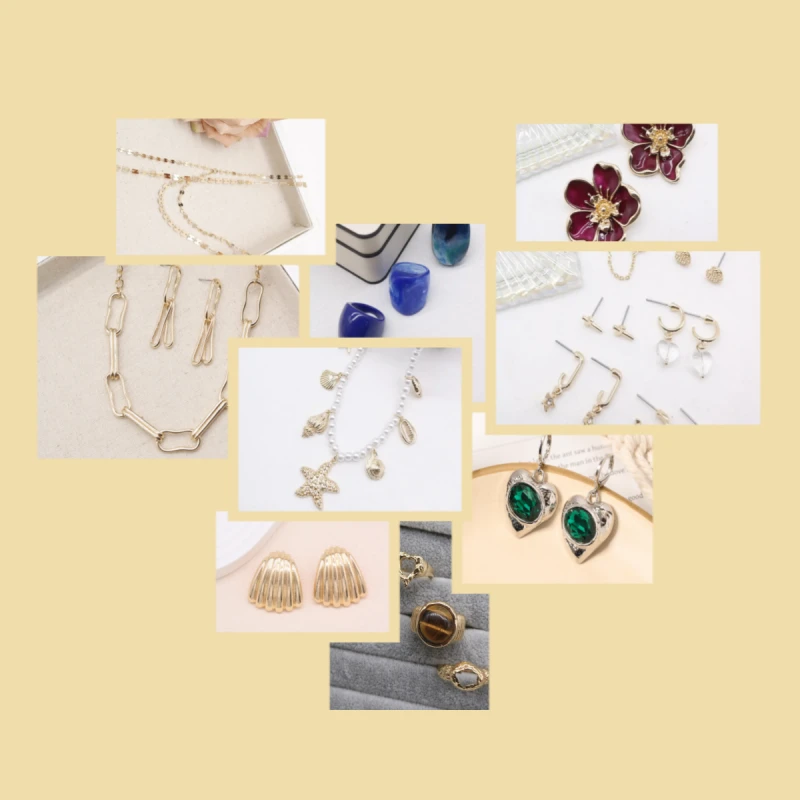
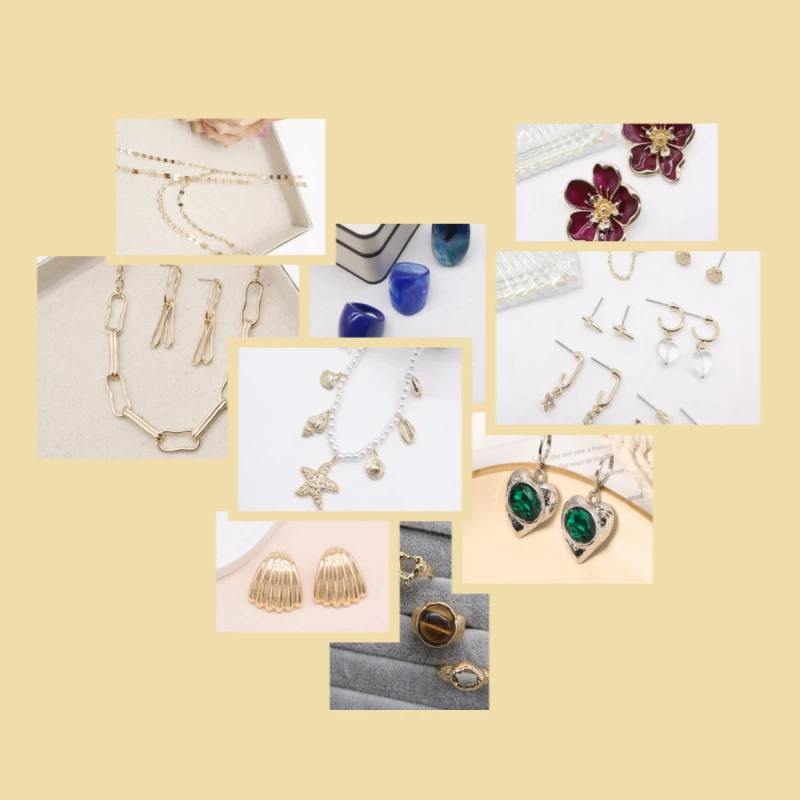
For example, a summer fashion collection might include colorful earrings, shell-inspired necklaces, and lightweight beaded bracelets.
Our custom earring collection includes different fashion jewelry directions suitable for developing coordinated retail assortments.
E-Commerce Businesses
Online jewelry sellers need products that are easy to describe, photograph, package, and ship.
Important purchasing considerations include:
Product dimensions
Accurate material descriptions
Consistent product appearance
Packaging protection
Size-related return risks
Inventory replenishment
Selling-platform requirements
Custom manufacturing can help online businesses establish more consistent product specifications and reduce reliance on constantly changing wholesale catalogs.
Jewelry Wholesalers and Distributors
Wholesale businesses typically require larger quantities, competitive purchasing costs, repeat-order availability, and consistent product quality.
Their manufacturing partners should be able to support multiple product categories, different order quantities, and changing seasonal requirements.
Promotional and Gift Businesses
Customized fashion jewelry can also be developed for promotional campaigns, gift collections, special events, and branded merchandise.
These projects may require specific colors, symbolic shapes, custom logos, or specialized packaging.
3. Choose the Right Custom Jewelry Manufacturing Model
Before requesting quotations, determine which manufacturing model suits your business.
OEM Jewelry Manufacturing
Original Equipment Manufacturing, or OEM, generally involves producing jewelry according to buyer-approved designs and specifications.
The buyer may provide:
Original sketches
CAD files
Technical drawings
Product measurements
Material specifications
Physical samples
Branding requirements
OEM manufacturing is suitable for businesses that already have established product designs or specific development requirements.
ODM Jewelry Manufacturing
Original Design Manufacturing, or ODM, involves additional product development support from the manufacturer.
A buyer may provide a design direction, reference images, target retail price, or collection theme. The manufacturer can then assist with design development, material selection, component sourcing, and sampling.
ODM is particularly useful for fashion retailers that want distinctive collections but do not maintain a full internal jewelry design team.
Private Label Jewelry Manufacturing
Private-label jewelry allows businesses to sell products under their own brand names.
Customization may include:
Branded jewelry cards
Logo tags
Engraving
Customized packaging
Selected product modifications
Coordinated brand collections
Private-label manufacturing does not automatically provide exclusive ownership of the underlying product design. Exclusivity should be negotiated and documented separately.
Comparison of Jewelry Sourcing Models
| Manufacturing Model | Design Control | Initial Investment | Development Requirements | Suitable Buyers |
|---|---|---|---|---|
| Ready-stock wholesale | Low | Relatively low | Minimal | New resellers |
| White label | Low | Low to moderate | Branding and packaging | Emerging retailers |
| Private label | Moderate | Project-dependent | Brand and product customization | Jewelry brands |
| ODM | Moderate to high | Project-dependent | Design and sample development | Fashion retailers |
| OEM | High | Project-dependent | Technical design and manufacturing | Established brands |
The most appropriate model depends on your available budget, design expertise, intended differentiation, and expected sales volume.
4. What Types of Custom Jewelry Are Suitable for Bulk Resale?
A commercially balanced jewelry collection should include products that match customer demand, retail price expectations, and inventory requirements.
Custom Necklaces
Necklaces offer numerous customization opportunities because buyers can combine different chains, pendants, charms, beads, and decorative materials.
Popular product directions include:
Initial necklaces
Pendant necklaces
Layered necklaces
Minimalist chain necklaces
Chunky statement necklaces
Pearl and beaded necklaces
Personalized charm necklaces
Our custom necklace collection provides examples of different necklace structures and fashion styles.
When sourcing necklaces, confirm the finished length, extension chain, clasp, pendant dimensions, and total product weight.
Custom Earrings
Earrings are suitable for both everyday accessory collections and seasonal fashion ranges.
Common styles include:
Stud earrings
Hoop earrings
Drop earrings
Statement earrings
Pearl earrings
Geometric earrings
Multi-pair earring sets
Earring buyers should pay particular attention to pair matching, post alignment, fastening security, decorative attachment, and wearing comfort.
A visually impressive earring may not be commercially successful if excessive weight makes it uncomfortable to wear.
Custom Rings
Fashion rings can be developed as individual products or coordinated multi-piece sets.
Adjustable rings can simplify selected inventory requirements, while fixed-size rings allow more controlled sizing.
Explore our custom fashion rings, including stackable rings, decorative metal bands, statement rings, and fashion ring sets.
For fixed-size products, define the sizing system, internal dimensions, and quantity required for each size.
Custom Bracelets and Bangles
Bracelets offer flexibility in chain structures, decorative charms, beads, and closures. Bangles provide additional opportunities for sculptural shapes, textures, and rigid wrist jewelry designs.
Our custom bracelet and bangle collection illustrates different wrist jewelry construction methods.
For bracelets, inspect clasp reliability and connection security. For rigid bangles, confirm internal dimensions, shape consistency, wall thickness, and wearing clearance.
Custom Brooches
Brooches are suitable for fashion retailers, gift collections, uniform accessories, and promotional jewelry programs.
They can feature floral designs, geometric motifs, decorative stones, enamel, and branded elements.
When sourcing custom brooches, evaluate pin construction, closure security, overall balance, and decorative component attachment.
Custom Anklets
Anklets are particularly suitable for lightweight fashion collections and seasonal accessories.
Common development options include delicate chains, decorative charms, beads, and adjustable extension chains.
Our custom anklet collection offers additional inspiration for coordinated jewelry assortments.
5. How to Build a Profitable Custom Jewelry Collection
One of the biggest purchasing mistakes is ordering products because they look attractive without considering how the collection will perform commercially.
A successful collection requires a balance of product appeal, retail pricing, manufacturing cost, inventory risk, and customer expectations.
Start with a Defined Customer Group
Before developing products, answer five questions:
Who will purchase your jewelry?
What retail prices are appropriate for these customers?
Which materials and finishes match their expectations?
Which products are likely to generate repeat purchases?
Which sales channels will you use?
A fashion boutique selling affordable everyday jewelry requires a different product strategy from a specialist retailer selling premium precious-metal accessories.
Use a Balanced Collection Structure
The following is an illustrative purchasing allocation for a 1,000-unit fashion jewelry launch.
| Product Category | Suggested Allocation | Quantity |
|---|---|---|
| Everyday necklaces | 30% | 300 |
| Fashion earrings | 30% | 300 |
| Bracelets and bangles | 20% | 200 |
| Rings and ring sets | 10% | 100 |
| Seasonal accessories | 10% | 100 |
| Total | 100% | 1,000 |
This allocation is an example rather than an industry-wide sales benchmark.
An established retailer should use historical sales data to determine its actual category mix. A new brand should consider testing demand before committing to large quantities of unfamiliar products.
The proposed assortment must also satisfy the manufacturer's MOQ for each individual design.
Develop Coordinated Collections
A coordinated collection can combine products using shared colors, materials, textures, and decorative motifs.
For example, a summer collection could include:
Gold-tone shell pendant necklaces
Coordinated pearl earrings
Beaded bracelets
Minimalist gold-tone rings
This approach creates a more consistent retail presentation and opportunities for customers to purchase complementary products.
Our Boho acrylic statement bead necklace illustrates how distinctive materials and decorative elements can support a seasonal fashion collection.
Avoid Excessive SKU Expansion
Every additional SKU introduces purchasing, packaging, photography, inventory management, and replenishment requirements.
For example, developing ten styles in three colors creates 30 SKUs before size variations are considered.
If each SKU requires 100 units, the total order becomes 3,000 units.
A smaller number of carefully selected designs may be easier to manage during the initial launch.
6. Where to Buy Custom Jewelry in Bulk for Resale
There are several ways to source wholesale and custom jewelry.
Direct Jewelry Manufacturers
Working directly with a manufacturer can be suitable when you need custom designs, consistent specifications, private-label packaging, or repeat production.
Potential advantages include:
Greater control over materials and construction
Product development support
Manufacturing transparency
Project-based quotations
Custom packaging
Repeat-order planning
However, direct manufacturing generally requires more preparation than purchasing existing stock.
Buyers should expect to spend time on design specifications, samples, testing, and production approval.
Domestic Jewelry Wholesalers
Domestic wholesalers can be useful when rapid replenishment and smaller mixed orders are priorities.
They may provide local inventory, shorter transportation times, and simpler purchasing arrangements.
Customization may be limited compared with direct manufacturing.
International B2B Marketplaces
Platforms such as Alibaba, Global Sources, and Made-in-China allow buyers to discover numerous jewelry suppliers.
These platforms can be useful for initial research, but supplier listings and verification badges do not eliminate the need for independent factory verification.
Jewelry Trade Shows
Trade shows allow buyers to examine samples, compare product quality, and discuss customization requirements directly with suppliers.
They are particularly useful when researching new materials, fashion trends, and collection development opportunities.
A successful trade show meeting should be followed by document verification, sample development, and relevant factory assessments.
Sourcing Agents and Manufacturing Coordinators
Sourcing agents may help businesses identify production partners, coordinate development, and manage suppliers.
Before working with an intermediary, establish its responsibilities, fees, manufacturing relationships, inspection procedures, and contractual accountability.
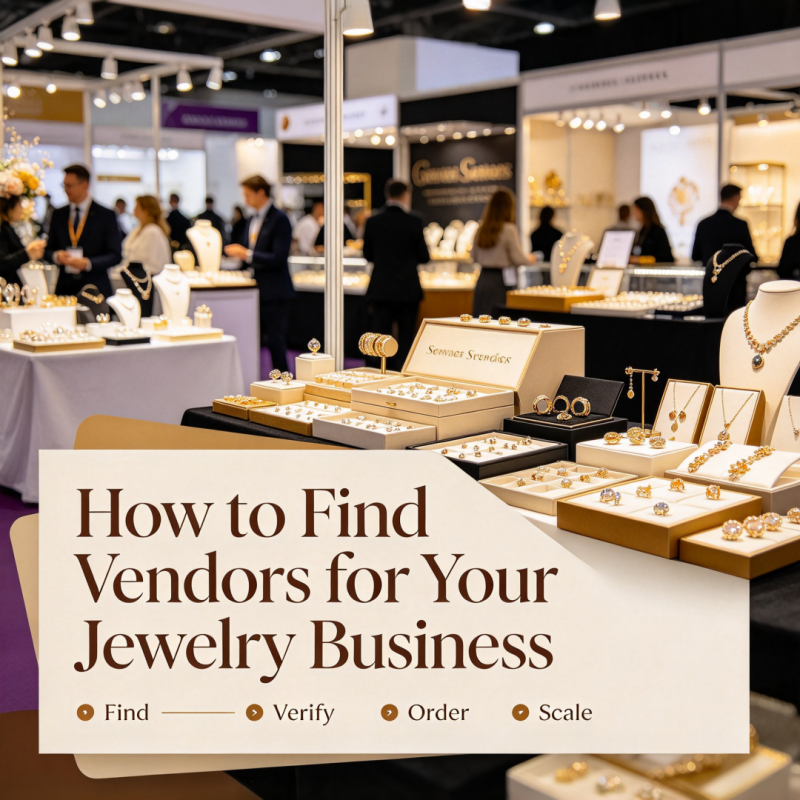
For additional sourcing methods, read our guide to finding vendors for your jewelry business.
7. How Much Does Custom Jewelry in Bulk Cost?
Custom jewelry manufacturing prices depend on several variables.
A simple cast-metal ring and a multi-component necklace with decorative stones should not be compared solely by their wholesale prices.
Main Jewelry Manufacturing Cost Factors
| Cost Factor | Impact on Purchasing Cost |
|---|---|
| Base material | Determines material and processing requirements |
| Product weight | Influences material consumption |
| Design complexity | Affects development, tooling, and assembly |
| Mold development | May increase initial project investment |
| Surface treatment | Influences finishing costs |
| Decorative components | Adds material and assembly requirements |
| Order quantity | Affects production efficiency |
| Packaging | Adds branding and material costs |
| Product testing | Depends on materials and destination requirements |
| Freight and duties | Affect final landed cost |
Actual Published Fashion Jewelry Price References
The following examples illustrate the price variation between different fashion jewelry products published on the Charmwell Accessories website.
| Product | Material | Published Reference Price | Listed MOQ |
|---|---|---|---|
| Acrylic statement bead necklace | Acrylic and plated metal components | Approx. US$1.30 | 200 |
| Five-piece gold-plated stackable ring set | Iron and zinc components | Approx. US$0.75 per set | 200 |
Our five-piece gold-plated stackable ring set is an example of a multi-piece fashion jewelry product designed for wholesale and retail distribution.
These are published product references, not guaranteed quotations for newly developed products.
The final cost depends on the approved specifications, order volume, customization, packaging, and other project requirements.
Charmwell's company-wide fashion jewelry pricing starts from approximately US$0.50 per piece for suitable products. More complex custom jewelry requires individual evaluation and quotation.
8. How to Calculate Landed Cost and Jewelry Resale Profit Margins
A common mistake among jewelry resellers is calculating profit using only the factory unit price.
The actual purchasing cost includes additional expenses required to bring the products into saleable inventory.
What Is Landed Cost?
Landed cost represents the cost of acquiring and delivering inventory to its intended destination.
A purchasing calculation may include:
Manufacturing cost
Sample and tooling cost
Custom packaging
Laboratory testing
Inspection services
Freight and insurance
Import duties
Brokerage and handling
Other applicable import expenses
For commercial planning, development and tooling expenses can be allocated across an initial order. Their accounting treatment may differ depending on the business.
Example: Landed Cost of a 1,000-Piece Jewelry Order
Consider a hypothetical private-label fashion jewelry project.
| Cost Item | Illustrative Cost |
|---|---|
| 1,000 jewelry units at $1.50 | $1,500 |
| Custom packaging | $120 |
| Sampling and tooling allocation | $200 |
| Testing and quality inspection | $180 |
| Freight and insurance | $400 |
| Estimated duties and handling | $100 |
| Total acquisition cost | $2,500 |
| Cost per purchased unit | $2.50 |
If 30 units are found to be unusable and cannot be recovered through replacement or supplier compensation, the business has 970 saleable units.
The effective acquisition cost becomes approximately $2.58 per saleable unit.
These figures are illustrative. Actual freight, duties, testing, and manufacturing costs must be calculated for the specific shipment.
How to Calculate Gross Margin
Gross margin is calculated as:
Gross Margin (%) = (Selling Price − Cost of Goods Sold) ÷ Selling Price × 100
Using an illustrative effective product cost of $2.58:
| Retail Selling Price | Gross Profit per Unit | Gross Margin |
|---|---|---|
| $7.99 | $5.41 | 67.7% |
| $9.99 | $7.41 | 74.2% |
| $12.00 | $9.42 | 78.5% |
| $14.99 | $12.41 | 82.8% |
| $19.99 | $17.41 | 87.1% |
These figures are mathematical examples, not expected industry profit margins.
Gross margin does not account for all business operating expenses.
Gross Profit vs. Actual Contribution
Assume the jewelry is sold for $12 through an online store.
| Cost or Revenue Item | Per Sale |
|---|---|
| Selling price | $12.00 |
| Effective product acquisition cost | −$2.58 |
| Platform and payment fees | −$1.20 |
| Fulfillment | −$1.50 |
| Customer acquisition and marketing | −$2.00 |
| Estimated contribution per sale | $4.72 |
| Estimated contribution margin | 39.3% |
Additional expenses may include refunds, customer service, software subscriptions, salaries, rent, and taxes.
A product with an attractive gross margin may still produce limited net profit if advertising costs or return rates are too high.
The objective is not simply to purchase jewelry cheaply. It is to acquire products that generate sustainable commercial returns.
9. MOQ Strategy: Should You Order 500, 1,000, or 5,000 Pieces?
Minimum order quantity is one of the most important factors when sourcing custom jewelry.
A lower MOQ can reduce initial inventory exposure, while higher quantities may improve production efficiency and reduce certain fixed costs per unit.
However, a large order is not automatically a better purchasing decision.
| Order Size | Illustrative Design Mix | Suitable Business Stage | Main Objective |
|---|---|---|---|
| 500 pieces | 5 designs × 100 | New brand or market test | Validate demand |
| 1,000 pieces | 5 designs × 200 | Developing retailer | Establish a repeatable collection |
| 5,000 pieces | 10 designs × 500 | Established brand or distributor | Scale proven products |
| 10,000+ pieces | Project-dependent | Larger purchasing programs | Improve supply planning |
These examples assume the manufacturer accepts the proposed quantities per design.
At Charmwell Accessories, standard MOQs start from 100 pieces per design for suitable projects. Many existing fashion jewelry listings specify 200 pieces.
Actual MOQ depends on:
Design complexity
Material availability
Mold development
Surface finishing
Color and size variations
Custom packaging
Production requirements
Calculate the Real MOQ Across Variations
Suppose you want to launch five necklace styles in three colors.
If the factory requires 100 units per style and color, your total order becomes:
5 styles × 3 colors × 100 units = 1,500 units.
If you assumed the MOQ applied only to each style, you might have budgeted for just 500 units.
Always confirm whether MOQ applies to:
Each design
Each color
Each size
Each material variation
Each packaging configuration
The complete order
This simple clarification can prevent substantial purchasing misunderstandings.
10. How to Verify a Custom Jewelry Manufacturer Before Ordering
Before placing a bulk jewelry order, buyers should verify the legal identity and production responsibilities of the supplier.
A professional website, attractive samples, and competitive quotations are useful starting points, but they are not sufficient evidence of manufacturing capability.
Verify the Legal Company
Request appropriate business information, including:
| Verification Item | Evidence to Review |
|---|---|
| Legal company name | Business registration documents |
| Production address | Actual manufacturing facility |
| Contracting entity | Quotation and sales contract |
| Payment information | Verified relationship to contracting entity |
| Manufacturing responsibilities | In-house and outsourced process list |
| Previous audit records | Relevant facility and audit scope |
| Product documentation | Material specifications and test reports |
For Chinese suppliers, public registration information can be checked where applicable through the National Enterprise Credit Information Publicity System.
Identify the Actual Manufacturing Facility
Some suppliers manufacture products internally. Others use specialist workshops or external manufacturing partners.
Outsourcing does not automatically make a supplier unsuitable.
The more important questions are:
Who controls production specifications?
Who approves the materials?
Who monitors subcontracted processes?
Who performs final inspection?
Who accepts responsibility when defects occur?
A transparent manufacturing partner should be able to explain these responsibilities clearly.
Conduct a Live Factory Tour
If an on-site visit is not possible, request a live video walkthrough of relevant facilities.
Ask to see:
Sample development
Mold-making resources
Casting or component preparation
Polishing and finishing
Assembly workstations
Quality inspection
Packaging operations
Production and material storage
A live tour can support preliminary verification, although independent inspections may be appropriate for larger or higher-risk projects.
11. Custom Jewelry Factory Audit: 12 Essential Inspection Areas
A jewelry factory audit should focus on the supplier's ability to manufacture your specific products consistently.
The following areas are especially important for bulk fashion jewelry sourcing.
11.1 Design and Product Development
Evaluate how the factory converts ideas, sketches, and reference images into manufacturable products.
Review design feasibility assessments, technical drawings, material selection, sample revisions, and product development records.
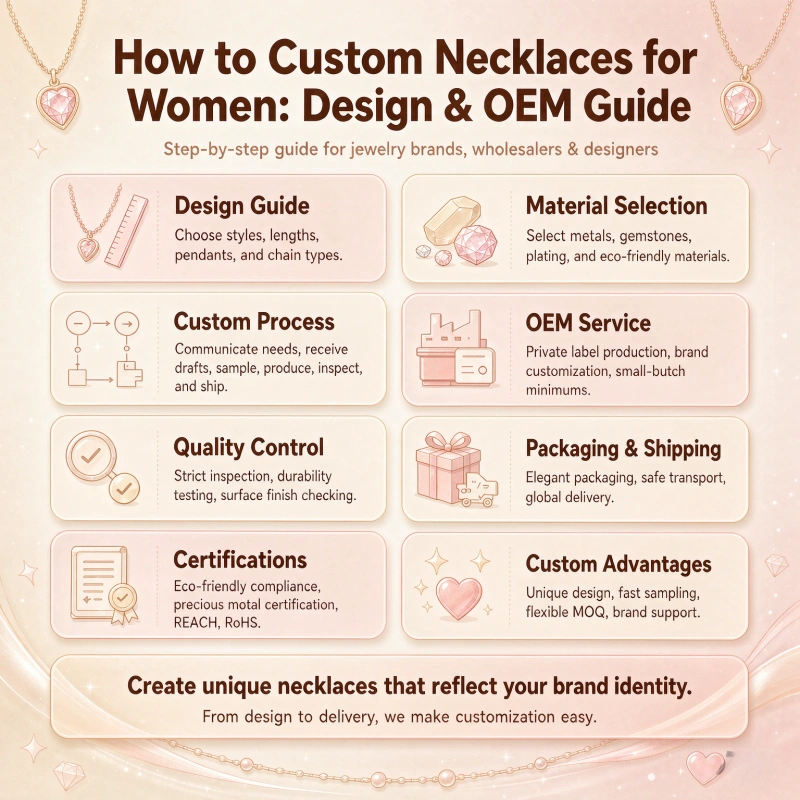
For example, our guide to custom necklaces for women explains why chain structure, pendant dimensions, and component compatibility need to be reviewed together.
11.2 Sampling Capability
Check the manufacturer's sample development resources and procedures.
Ask whether samples are made with the same intended materials and manufacturing methods as the bulk order.
A sample made from different components may create an inaccurate impression of the final product.
11.3 Mold Making and Tooling
For custom cast jewelry, examine the supplier's tooling development capabilities.
Confirm mold costs, ownership, storage, maintenance, dimensional control, and future availability.
Original molds should not be used for unauthorized third-party production when exclusivity has been contractually agreed.
11.4 Raw Material Traceability
Check how base metals, chains, clasps, stones, beads, and other decorative components are identified and recorded.
The manufacturer should have a defined process for handling material substitutions.
An approved gold-tone brass design should not be changed to a different base metal without the buyer's authorization.
11.5 Casting and Forming
Review casting consistency, component dimensions, surface defects, wall thickness, and edge finishing.
These checks are particularly relevant to decorative pendants, chunky rings, bangles, and sculptural fashion jewelry.
11.6 Electroplating and Surface Finishing
Plating consistency is critical for coordinated jewelry collections.
Check whether the supplier controls:
Approved color references
Base material preparation
Plating specifications
Surface appearance
Coating thickness where specified
Adhesion and wear-testing requirements
Batch-to-batch color differences
If plating is outsourced, verify how the manufacturer controls its external finishing partner.
11.7 Jewelry Assembly
Inspect how chains, connecting rings, clasps, stones, pearls, and decorative elements are assembled.
Poor component attachment can lead to product failures even when the initial appearance is satisfactory.
11.8 Dimensional Accuracy
Different product types require different dimensional controls.
| Product | Important Measurements |
|---|---|
| Necklace | Chain length, pendant size, extension length |
| Earring | Height, width, weight, post position |
| Ring | Internal diameter, band width, size |
| Bracelet | Finished length, clasp and extension |
| Bangle | Internal dimensions, band width, opening |
| Brooch | Overall dimensions and pin placement |
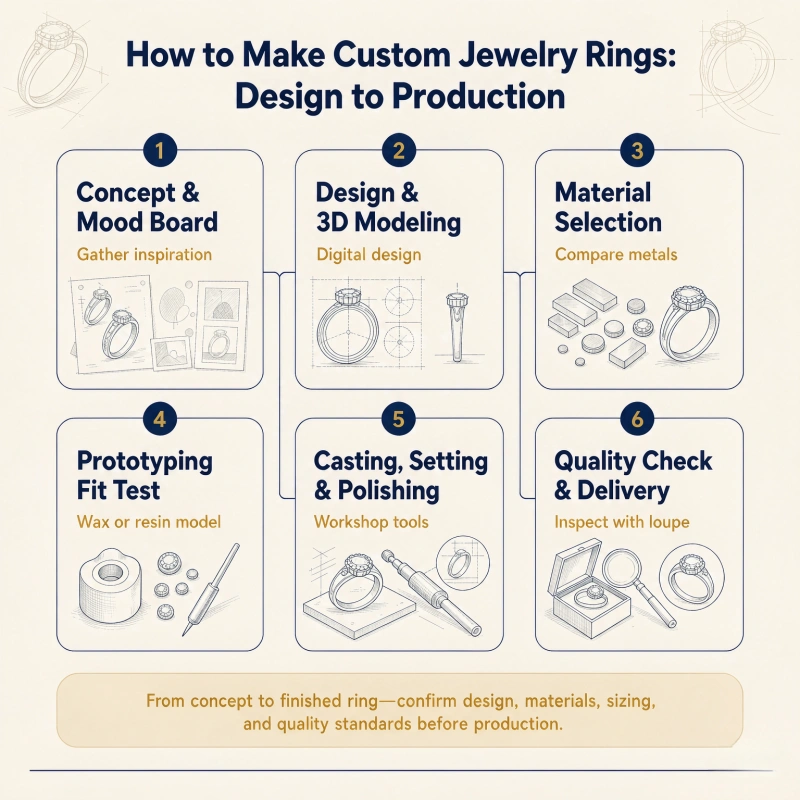
For ring development, see our guide to making custom jewelry rings.
11.9 Quality Management
Ask for relevant inspection procedures, defect classifications, production records, and corrective action reports.
The supplier should be able to demonstrate how defects are identified, corrected, and prevented from recurring.
11.10 Product Compliance
Verify applicable product safety requirements and laboratory documentation for your destination market.
A generic factory certificate should not be treated as evidence that every jewelry product complies with every regulation.
11.11 Private Label Packaging
Check whether the manufacturer can consistently manage branding, labels, barcodes, SKU identification, retail cards, pouches, and gift boxes.
Packaging errors can delay the retail launch even when the jewelry itself passes inspection.
11.12 Production Capacity and Repeat-Order Reliability
Review actual production capacity, material procurement arrangements, existing production commitments, and expected manufacturing bottlenecks.
A large annual capacity does not necessarily guarantee immediate availability for a specific order.
For ongoing cooperation, evaluate the supplier's actual delivery and quality performance.
12. A 100-Point Factory Audit Scorecard for Bulk Jewelry Buyers
The following evaluation model helps buyers compare manufacturers using consistent purchasing criteria.
It is a proposed supplier assessment tool rather than an official certification standard.
| Factory Audit Category | Maximum Score | Evidence Required |
|---|---|---|
| Business verification and transparency | 10 | Legal documents and production locations |
| Product design and sampling | 15 | Development records and approved samples |
| Manufacturing and tooling | 15 | Relevant equipment and process capabilities |
| Material and plating controls | 15 | Material specifications and process records |
| Quality management | 20 | Inspection and corrective action records |
| Product compliance | 10 | Relevant test reports |
| Capacity and delivery | 10 | Production plans and performance records |
| Private label and commercial support | 5 | Packaging and purchasing agreements |
| Total | 100 |
Suggested Factory Evaluation Results
| Audit Score | Recommendation |
|---|---|
| 90–100 | Strong candidate for trial production |
| 80–89 | Suitable after remaining issues are resolved |
| 70–79 | Conditional approval requiring corrective actions |
| Below 70 | Further verification required before bulk purchasing |
Scores should reflect the available evidence rather than the supplier's verbal assurances.
A serious unresolved product safety issue, falsified documentation, undisclosed material substitution, or significant labor violation should prevent supplier approval regardless of the total score.
13. How to Verify Jewelry Quality Before Bulk Production
Quality problems are less expensive to resolve during development than after thousands of products have been manufactured.
A structured approval process should include several stages.
Prototype Sample
The initial prototype establishes the product's general appearance and structure.
Review:
Design proportions
Material suitability
Dimensions
Construction
Wearing comfort
Revised Sample
The revised sample incorporates approved changes from the first development stage.
All revisions should be recorded to avoid misunderstandings during subsequent production.
Pre-Production Sample
The pre-production sample should represent the intended bulk-production specifications.
Confirm the actual materials, decorative components, surface finish, size, branding, and packaging.
Golden Sample
The golden sample is the final approved physical reference used for production and inspection.
Both parties should retain an approved reference where practical.
It should be supported by a written specification that defines acceptable dimensions, materials, appearance, functionality, and packaging.
Bulk Production Inspection
During production, evaluate whether the actual products remain consistent with the approved specifications.
Final inspection should cover:
| Inspection Area | Typical Check |
|---|---|
| Appearance | Scratches, dents, discoloration |
| Dimensions | Approved lengths, widths, and sizes |
| Surface finish | Color and coating consistency |
| Construction | Connection and assembly quality |
| Components | Correct stones, beads, and clasps |
| Functionality | Opening, closing, and adjustment |
| Packaging | Correct branding and quantities |
| SKU identification | Accurate labels and barcodes |
For larger orders, buyers may arrange independent pre-shipment inspection using an agreed sampling plan.
An accepted inspection does not guarantee that every unit is defect-free. Inspection criteria and defect-handling responsibilities should be established before manufacturing.
14. Jewelry Safety and Compliance for International Resale
Jewelry importers and retailers should understand the regulatory requirements of their intended sales markets.
Relevant requirements depend on materials, product type, customer age group, intended use, and destination.
European Union Requirements
For jewelry covered by EU REACH restrictions, important examples include:
| Substance or Exposure | General Regulatory Limit |
|---|---|
| Nickel release from relevant articles in direct and prolonged skin contact | 0.5 µg/cm²/week |
| Nickel release from posts inserted into pierced parts of the body | Less than 0.2 µg/cm²/week |
| Cadmium in covered metal jewelry components | Below 0.01% by weight of metal |
| Lead in individual covered jewelry parts | Below 0.05% by weight |
Source: EU REACH Regulation, Annex XVII.
Specific conditions and exemptions apply. Confirm the applicable requirements with a qualified testing laboratory and review the current regulations before production.
United States Requirements
Jewelry sold in the United States may be subject to federal and state requirements depending on the product and intended customer.
Children's jewelry can involve additional testing, certification, lead-content restrictions, and other safety obligations.
Buyers should review guidance from the U.S. Consumer Product Safety Commission and confirm relevant state requirements.
Verify Product-Specific Laboratory Reports
A useful laboratory report should identify:
Tested product or component
Sample description
Testing laboratory
Test method
Test date
Applicable limit
Test result
The report should be relevant to the actual materials and construction of your order.
A report covering one necklace does not automatically establish compliance for an entire jewelry collection.
15. How to Sell Bulk Custom Jewelry Through Different Retail Channels
Your intended resale channel should influence how products are designed, purchased, packaged, and marketed.
| Sales Channel | Purchasing Priority | Recommended Focus |
|---|---|---|
| Independent boutiques | Product appearance and assortment | Coordinated collections |
| Own e-commerce store | Brand differentiation and product information | OEM and private label |
| Amazon | Consistent specifications and inventory | Repeatable SKU management |
| Etsy | Eligibility under marketplace creativity rules | Original or eligible personalized designs |
| Wholesale distribution | Cost and replenishment | Stable production |
| Fashion retail chains | Quality consistency and delivery schedules | Documented production controls |
| Gift businesses | Presentation and customization | Packaging and themed designs |
Selling Jewelry Through Your Own Online Store
An independent online store provides greater control over brand identity, product presentation, and customer relationships.
However, the business must manage customer acquisition, payment processing, fulfillment, returns, and applicable legal requirements.
Selling Custom Jewelry on Etsy
Etsy is not a general marketplace for unrestricted resale of mass-produced jewelry.
Its current Creativity Standards distinguish between seller-made products, original seller designs produced by qualifying production partners, and other specifically permitted items.
Simply adding a brand label to a standard wholesale product does not automatically make it eligible.
Businesses using production partners should review Etsy's Creativity Standards and disclose their production partners where required.
Selling Jewelry Through Amazon and Other Marketplaces
For marketplace sellers, product descriptions, inventory accuracy, material disclosures, packaging, and applicable product documentation are particularly important.
Requirements may vary by marketplace, country, and product category. Buyers should confirm the applicable seller policies before committing to inventory.
16. How to Manage Inventory and Repeat Orders
Bulk purchasing becomes commercially valuable when the business can sell products efficiently and replenish successful designs.
Ordering excessive quantities of untested products can create unnecessary inventory exposure.
Monitor Sell-Through Rate
Sell-through rate measures the proportion of available inventory sold during a defined period.
Sell-Through Rate (%) = Units Sold ÷ Available Units for Sale × 100
Suppose a jewelry brand receives 1,000 units and sells 700 during the first 60 days.
Its 60-day sell-through rate is 70%, assuming all 1,000 units were available and no additional stock was received.
The remaining 300 units represent inventory that still needs to be sold, discounted, or otherwise managed.
Use Sales Data to Plan Reorders
Consider the following hypothetical 30-day inventory results.
| Product | Initial Inventory | Units Sold | Sell-Through |
|---|---|---|---|
| Chain necklace | 200 | 160 | 80% |
| Hoop earrings | 200 | 140 | 70% |
| Pearl bracelet | 200 | 100 | 50% |
| Ring set | 200 | 80 | 40% |
| Statement necklace | 200 | 50 | 25% |
The faster-selling necklace and earrings may deserve earlier replenishment, while the slower products require additional analysis before a repeat order.
However, sell-through should be considered alongside contribution margin, customer returns, seasonality, and expected replenishment time.
Calculate a Reorder Point
A simplified reorder model is:
Reorder Point = Average Daily Sales × Total Replenishment Lead Time + Safety Stock
If a necklace sells an average of five units per day, replenishment takes 50 days, and the business maintains 30 units of safety stock, the illustrative reorder point is:
5 × 50 + 30 = 280 units.
Actual reorder planning should also consider demand variability, transportation, customs clearance, and existing purchase orders.
For custom jewelry, replenishment lead time must include more than the manufacturer's production schedule.
17. How to Reduce Risks When Purchasing Jewelry in Bulk
Do Not Select a Manufacturer Based Only on Price
Consider two hypothetical suppliers quoting the same 1,000-unit jewelry order.
| Purchasing Indicator | Supplier A | Supplier B |
|---|---|---|
| Quoted unit price | $1.00 | $1.08 |
| Total product cost | $1,000 | $1,080 |
| Unusable products | 100 | 20 |
| Saleable products | 900 | 980 |
| Effective product cost | $1.11 | $1.10 |
Although Supplier A offers a lower initial price, Supplier B provides a slightly lower effective cost per saleable product.
The example excludes replacements, returns, transportation, and other associated expenses.
The lesson is to compare acceptable finished products rather than focusing exclusively on quoted prices.
Require Written Product Specifications
Every purchase order should clearly identify materials, dimensions, surface finish, branding, packaging, approved sample references, and inspection criteria.
Establish a Defect Resolution Agreement
Before placing an order, agree on how defective products will be handled.
Possible arrangements include replacement, repair, credit, refund, or other negotiated corrective actions.
The agreement should also define claim deadlines and required evidence.
Protect Your Original Designs
For exclusive collections, discuss intellectual property ownership, tooling ownership, confidentiality, and authorized production quantities.
An OEM arrangement does not automatically establish every aspect of intellectual property ownership.
Appropriate written agreements should be used for significant original-design projects.
Start with Controlled Production
A carefully planned trial order allows the buyer to evaluate manufacturing quality, packaging, delivery, and customer acceptance before expanding purchasing quantities.
This approach is particularly useful when developing a new product structure or working with an unfamiliar supplier.
18. Custom Jewelry in Bulk for Resale from Charmwell Accessories
Charmwell Accessories is the brand of Qingdao Charmwell Industry & Trading Co., Ltd., a China-based fashion jewelry manufacturer established in 2013.
We support jewelry brands, fashion retailers, wholesalers, distributors, importers, and e-commerce businesses through OEM manufacturing, ODM development, private-label services, and bulk fashion jewelry production.
Our approach combines product development, material sourcing, sampling, manufacturing, quality inspection, and packaging coordination.
Our Custom Jewelry Manufacturing Capabilities
| Manufacturing Indicator | Charmwell Accessories |
|---|---|
| Established | 2013 |
| Markets served | More than 50 countries |
| Sampling department | 10 sample makers |
| Monthly sample development | Approximately 1,000 samples |
| In-house mold-making team | 5 mold makers |
| Annual production capacity | Approximately 5–7 million jewelry units |
| Standard MOQ | From 100 pieces per design, subject to requirements |
| Reference product pricing | From approximately US$0.50 for suitable products |
| Initial sample development | Typically 7–15 days |
| Standard bulk production | Approximately 5–6 weeks after approval |
| Quality inspection | All shipments inspected before release, as reported by the company |
These figures represent our published company information. The actual manufacturing schedule, MOQ, cost, and development requirements depend on the individual project.
OEM Jewelry Services
We can review customer designs, reference photographs, technical drawings, and physical samples to determine appropriate manufacturing options.
Our OEM services can support original fashion jewelry designs and repeat production based on approved specifications.
ODM Jewelry Development
Our design and sampling resources help customers develop coordinated collections based on fashion directions, material preferences, target customers, and desired price positioning.
Private Label Jewelry Services
Depending on the project, private-label customization can include logo tags, engraving, jewelry cards, branded packaging, and customized retail presentation.
Quality Control and Manufacturing Transparency
We encourage buyers to discuss product specifications, sampling requirements, material controls, inspection criteria, and applicable testing before confirming bulk production.
For more information about our design team, sampling department, mold-making resources, manufacturing capabilities, and quality procedures, visit our About Charmwell Accessories page.
19. How to Order Custom Jewelry in Bulk: Step-by-Step
The following purchasing process helps jewelry businesses move from concept development to completed orders.
| Step | Purchasing Activity | Expected Outcome |
|---|---|---|
| 1 | Submit designs and requirements | Initial project evaluation |
| 2 | Confirm materials and specifications | Technical feasibility |
| 3 | Receive quotation | Budget and MOQ confirmation |
| 4 | Develop physical samples | Product evaluation |
| 5 | Approve samples and revisions | Final production reference |
| 6 | Confirm purchase order and terms | Commercial agreement |
| 7 | Begin bulk production | Manufacturing |
| 8 | Conduct quality inspection | Verify agreed specifications |
| 9 | Complete packaging and shipment | Delivery preparation |
| 10 | Review sales and quality performance | Repeat-order planning |
What to Include in Your Request for Quotation
To obtain an accurate manufacturing quotation, provide the following information:
Product category and design references
Preferred base materials
Product dimensions and size variations
Surface finish and color
Decorative components
Estimated quantity per design
Target price range
Destination country
Product testing requirements
Logo and packaging requirements
Expected delivery schedule
A complete request helps the manufacturer evaluate your project and identify potential production challenges before development begins.
20. Frequently Asked Questions About Custom Jewelry in Bulk for Resale
Can I buy custom jewelry in bulk and resell it under my own brand?
Yes. Private-label and OEM manufacturing allow businesses to sell jewelry under their own brands, subject to design ownership, contractual arrangements, applicable laws, and sales-platform requirements.
Where is the best place to buy custom jewelry in bulk?
The best sourcing channel depends on your business requirements. Domestic wholesalers are useful for rapid replenishment, while direct manufacturers are often more suitable for custom design development, private-label packaging, and repeat production.
How much does wholesale custom jewelry cost?
Prices vary according to material, weight, design complexity, decorative components, surface finish, order quantity, and packaging. Charmwell offers selected fashion jewelry products starting from approximately US$0.50 per piece, with project-specific quotations for custom designs.
What is the MOQ for custom jewelry in bulk?
Charmwell's standard MOQ starts from 100 pieces per design for suitable projects. Many existing fashion jewelry products have published MOQs of 200 pieces. Actual requirements depend on materials, designs, colors, sizes, and production conditions.
Is buying jewelry in bulk profitable?
It can be profitable when products match customer demand and the selling price covers manufacturing, transportation, packaging, selling fees, marketing, returns, and operating costs. Profitability depends on the individual business rather than a guaranteed industry margin.
What is the difference between OEM and private-label jewelry?
OEM manufacturing generally produces jewelry according to buyer-approved designs and specifications. Private-label manufacturing focuses on selling products under the buyer's brand and may use existing or customized designs.
How do I check if a jewelry factory is reliable?
Verify its legal identity, actual production locations, sampling capability, material controls, manufacturing processes, quality records, and relevant testing documentation. A controlled trial order can provide additional evidence of production performance.
Should I request samples before ordering jewelry in bulk?
Yes. Physical samples help buyers evaluate appearance, material, dimensions, construction, wearing comfort, finish, and packaging before approving larger production quantities.
Can I order different jewelry designs in one shipment?
Depending on the manufacturing arrangement, multiple designs and product categories can be included in a coordinated purchasing project. Confirm the MOQ and production requirements for each design.
How long does custom jewelry manufacturing take?
Charmwell's published initial sample development time is approximately 7–15 days, with standard bulk production taking approximately 5–6 weeks after sample approval. Actual schedules depend on the project.
Can I customize jewelry packaging and logos?
Yes. Available options may include branded jewelry cards, logo tags, engraving, labels, pouches, gift boxes, and retail-ready packaging.
Can I sell wholesale jewelry on Etsy?
Ordinary mass-produced jewelry resale is generally restricted on Etsy. Original seller-designed products made by qualifying production partners and certain personalized products may be eligible. Review Etsy's current rules before sourcing inventory.
How can I reduce inventory risks when buying jewelry in bulk?
Start with a controlled assortment, validate customer demand, monitor sell-through rates, calculate landed costs, and increase order quantities primarily for proven products.
Can Charmwell support small jewelry businesses?
Yes. We work with emerging brands as well as established retailers and wholesalers. MOQ, customization, sampling, and production arrangements are confirmed according to each project's requirements.
Conclusion: Build a Sustainable Custom Jewelry Resale Business
Buying custom jewelry in bulk for resale is not simply a strategy for obtaining cheaper products. It is an opportunity to develop distinctive collections, establish brand identity, control product specifications, and build a reliable supply chain.
The most successful sourcing decisions combine market research, realistic purchasing budgets, manufacturer verification, factory audits, approved physical samples, product compliance, and effective inventory management.
Rather than focusing entirely on the lowest wholesale price, evaluate the complete cost of saleable products and the manufacturer's ability to support consistent repeat production.
At Charmwell Accessories, we help international jewelry businesses develop custom fashion jewelry collections through OEM, ODM, private-label manufacturing, sampling, quality inspection, and bulk production.
Whether you are launching your first jewelry brand, expanding a retail assortment, or seeking a long-term manufacturing partner, our team can discuss your product development and purchasing requirements.
Ready to buy custom jewelry in bulk for resale?
Send us your design ideas, preferred materials, estimated quantities, target prices, and packaging requirements.
Contact Charmwell Accessories to request a custom jewelry quotation and start developing your next collection.