Custom jewelry rings allow you to turn a simple design idea into a product that reflects a personal style, brand identity, or specific market demand. Whether you want to create minimalist bands, stackable rings, pearl rings, colorful resin rings, or statement designs, the process involves more than choosing an attractive shape.
To make custom jewelry rings successfully, you need to define the design, select suitable materials, confirm ring dimensions, develop a sample, and establish clear manufacturing specifications. For jewelry brands and retailers, you also need to consider minimum order quantities, production costs, quality inspection, and private-label packaging.
This guide explains how to make custom jewelry rings step by step. It covers popular ring styles, material selection, sizing, manufacturing methods, cost factors, and OEM/ODM production so you can turn your concept into a commercially viable jewelry collection.
1. Decide What Type of Custom Jewelry Ring You Want to Make
The first step is to define the type of ring you want to create. Different ring structures require different materials, production methods, and design considerations.
For fashion jewelry brands, six popular ring categories provide useful starting points.
1.1 Minimalist Band Rings
Minimalist rings feature simple shapes, clean surfaces, and relatively restrained decorative details.
Common options include:
Smooth metal bands
Thin gold-tone or silver-tone rings
Twisted or textured bands
Geometric open rings
Stacking rings with subtle details
These designs are suitable for everyday jewelry collections and retailers looking for versatile products.
For inspiration, explore our gold-plated stackable ring set, which combines different band profiles in one coordinated collection.
1.2 Stackable Ring Sets
Stackable rings are designed to be worn individually or combined on the same finger or across several fingers.
A set may contain rings with different widths, textures, colors, or decorative elements.
When designing a stackable collection, consider:
Whether the rings look attractive individually
Whether the band widths work together
Whether the surfaces create too much friction when stacked
Whether the ring sizes are consistent
Whether the total combination feels comfortable
A practical development approach is to create three to five complementary designs rather than simply putting several unrelated rings into one pack.
Charmwell's two-piece hammered ring set is an example of combining coordinated textures for a unified product presentation.
1.3 Statement and Chunky Rings
Statement rings use larger decorative shapes, wider bands, bold textures, or oversized details.
They may feature:
Sculptural metal shapes
Vintage-inspired patterns
Large decorative stones
Chunky resin structures
Irregular or organic surfaces
For these products, weight and wearing comfort are especially important. A ring that looks attractive in a product photograph may feel uncomfortable if the band is too heavy or the inner surface is poorly finished.
See our vintage chunky gold-plated ring set for an example of a bold fashion ring direction.
1.4 Pearl and Beaded Rings
Pearl rings combine decorative pearl-like elements with metal, acrylic, or other supporting structures.
Depending on the design, you can develop:
Single-pearl rings
Multiple-pearl rings
Irregular pearl arrangements
Vintage-inspired pearl settings
Pearl and metal combination rings
Pay attention to how each decorative element is attached. The attachment method should be appropriate for the component's size, weight, and intended use.
Explore our fashion pearl ring set and boho burnished pearl ring design for examples of decorative ring combinations.
1.5 Stone-Set and Decorative Rings
Rings with stones or glass accents use decorative components to create visual contrast and attract attention.
Possible design elements include:
Glass stones
Cubic zirconia
Decorative natural stones
Simulated gemstones
Colored resin or enamel details
For a successful design, specify the decorative component's shape, dimensions, color, and attachment method.
If a design uses prong, bezel, or other mechanical settings, the setting must be developed around the actual component dimensions. Do not assume that a stone with the same nominal size will always fit an existing setting.
Our gold-plated tiger's-eye stone ring set illustrates how stone details can become the central feature of a fashion ring collection.
1.6 Adjustable and Open Rings
Adjustable rings use an open or flexible structure that can accommodate a limited range of finger sizes.
They are useful when:
A retailer wants to reduce the number of fixed sizes.
The product is designed as a fashion accessory.
The target market prefers flexible styling.
The ring is intended for gifting when the exact size is uncertain.
However, adjustable does not mean universal fit.
The manufacturer should confirm the supplied opening, recommended adjustment range, band material, and safe adjustment method. Repeatedly bending a metal ring beyond its intended range can weaken the structure.
2. Choose the Right Materials for Custom Jewelry Rings
Material selection affects the appearance, weight, manufacturing method, cost, and final retail positioning of a custom ring.
Before developing a sample, decide whether your project is a fashion jewelry collection or a fine jewelry product. These categories have different material specifications and manufacturing requirements.
2.1 Zinc Alloy
Zinc alloy is commonly used for decorative fashion jewelry components and shaped ring designs.
Its advantages include:
Flexibility for creating decorative shapes
Suitability for casting and detailed forms
Compatibility with different surface finishes
Potentially competitive production costs
It is often selected for statement rings, decorative bands, and multi-piece fashion ring sets.
However, the actual alloy specification and surface treatment should be confirmed rather than relying on the general term zinc alloy.
2.2 Brass and Other Metal Components
Brass can be used in selected fashion jewelry structures and decorative components.
When considering brass, confirm the alloy composition, component dimensions, surface treatment, and final color.
For mixed-material designs, specify which components use brass and which use other materials. This is particularly important when a ring combines a metal base with a decorative top section.
2.3 Iron
Iron is used in some fashion jewelry structures and decorative components.
It can be considered for selected ring styles where the required shape, construction, and surface treatment are suitable.
The manufacturer should assess corrosion protection, edge finishing, and compatibility with the selected coating or plating process.
2.4 Acrylic and Resin
Acrylic and resin are useful for colorful, lightweight, and visually distinctive fashion rings.
They can support:
Transparent or translucent designs
Solid-color rings
Gradient colors
Oversized geometric shapes
Decorative heart, flower, and abstract forms
Resin and acrylic are especially useful when the design relies on color, volume, or a non-metallic appearance.
For example, our chunky gradient resin ring set demonstrates how resin can be used to create a coordinated collection with multiple colors.
2.5 Glass, Pearls, and Decorative Stones
Glass stones, simulated pearls, and decorative stones add color and texture to metal ring structures.
When using these components, confirm:
Exact size and shape
Color reference
Surface appearance
Attachment method
Acceptable variation between components
Inspection requirements
For example, a two-piece ring set using gold-tone zinc alloy and glass stones requires separate checks for metal finish, stone color, fit, and component security.
See our minimalist gold-plated glass stone ring set for a related product example.
2.6 Gold-Tone and Silver-Tone Finishes
Gold-tone and silver-tone finishes are widely used in fashion jewelry.
A gold-colored ring is not necessarily made from solid gold. It may use a base metal with a plated or coated surface.
When requesting a custom finish, confirm:
Base metal
Plating or coating process
Color reference
Surface gloss or texture
Any specified coating requirements
Testing standards for the destination market
Avoid using precious-metal descriptions such as solid gold or 18K gold unless the actual material composition supports those claims.
For more information, see our guide to how much gold-plated jewelry costs.
3. Define the Ring Design and Technical Specifications
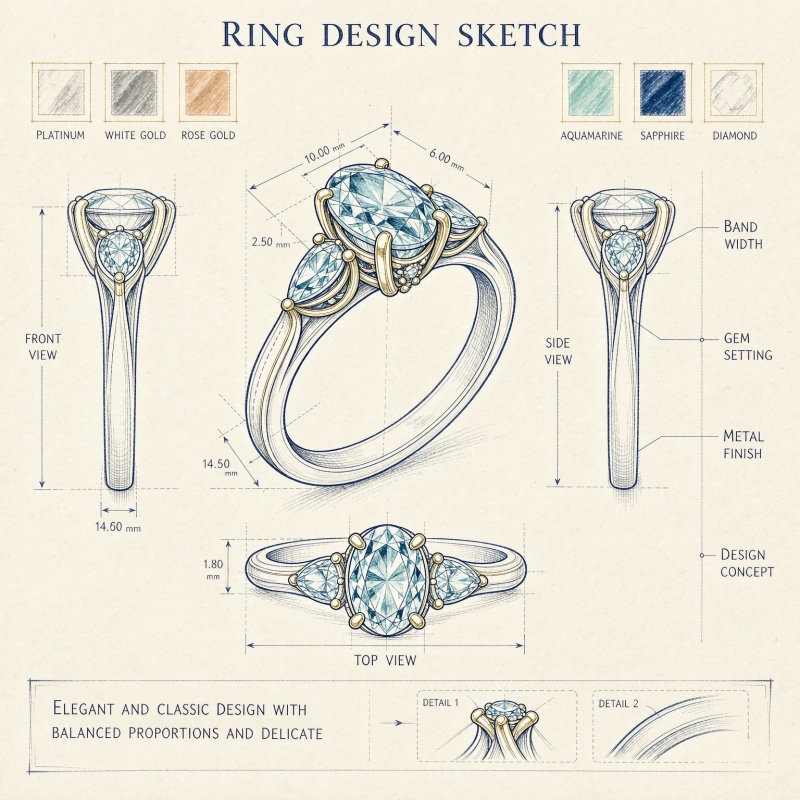
A sketch or reference photograph can communicate your creative direction, but a manufacturer needs measurable specifications to develop a repeatable product.
A good custom ring design brief should explain the structure from the top, side, and inside of the ring.
3.1 Choose the Overall Ring Shape
Start by deciding the basic design structure:
Round or oval band
Square or geometric band
Open ring
Twisted band
Multi-row design
Wide statement band
Decorative top or centerpiece
The structure determines how the ring sits on the finger and how much material is required.
3.2 Specify Band Width and Thickness
Band width and thickness are two separate measurements.
Width describes how much of the finger the ring covers from one side to the other. Thickness describes the material depth.
For example, a specification might include:
| Measurement | Illustrative Specification |
|---|---|
| Band width | 4 mm |
| Band thickness | 1.5 mm |
| Inner diameter | 17.3 mm |
| Surface finish | Gold tone |
| Ring structure | Closed band |
These are example dimensions, not universal specifications.
A wider ring may require additional consideration for finger comfort and sizing. A very thin or delicate structure may also need a technical review to confirm that it is suitable for the chosen material and production process.
3.3 Decide Between Fixed-Size and Adjustable Construction
There are two main options for fashion ring sizing.
Fixed-size rings are manufactured to defined measurements. They offer more controlled sizing but may require multiple sizes in the product range.
Adjustable rings use an open construction to accommodate a specified range. They can simplify some product assortments but should not be marketed as fitting every finger.
For B2B orders, specify the size system and quantity required for each size or adjustment range.
3.4 Add Decorative and Branding Details
A ring can be customized through more than its shape.
Possible details include:
Engraved patterns
Textured or hammered surfaces
Pearl and stone arrangements
Enamel colors
Logo engraving
Branded jewelry cards
Private-label packaging
If you want to create a themed collection, keep certain elements consistent across different ring styles. For example, using a shared gold-tone finish, repeated geometric details, or a coordinated color palette can make several designs look like one collection.
Our pink enamel acrylic heart ring set is an example of combining colored decorative elements with a coordinated multi-piece design.
4. How to Choose the Correct Ring Size
Ring sizing is one of the most important parts of custom ring development.
A ring may have an attractive design and good finishing but still fail as a retail product if the sizing is inaccurate.
4.1 Understand Different Ring Sizing Systems
Different markets use different ring sizing systems, including US, UK, and European measurements.
A manufacturer should know which sizing standard your product will use before production starts.
The following examples show approximate US sizes and their corresponding internal measurements based on the GIA international ring size chart.
| US Ring Size | Inside Diameter | Inside Circumference |
|---|---|---|
| US 6 | 16.5 mm | 51.8 mm |
| US 7 | 17.3 mm | 54.3 mm |
| US 8 | 18.1 mm | 56.9 mm |
| US 9 | 19.0 mm | 59.7 mm |
Reference: GIA Ring Size Guide and International Ring Size Chart.
These measurements are useful references, but the final size should be checked using the correct sizing system and a suitable measuring tool.
4.2 Do Not Rely Only on Paper or String Measurements
Wrapping paper or string around a finger may produce inaccurate results because it can stretch, shift, or fail to account for the knuckle.
The GIA recommends having a jeweler measure the finger with a ring sizer for a more reliable fit. Temperature, humidity, time of day, and finger position can also influence measurements.
For commercial production, use a confirmed size specification and inspect the sample against the corresponding measurement.
4.3 Consider Band Width When Checking Fit
A wide band may feel tighter than a narrow band with the same nominal ring size.
This is why a sample should be tested with its actual band width and inner profile.
For a multi-ring set, check each ring separately. Different widths and shapes can create different wearing experiences even when the nominal size is the same.
4.4 Plan Size Assortments for Retail
For wholesale and private-label projects, do not simply order the same quantity of every size without understanding the target market.
Consider:
Main customer demographic
Target country and sizing system
Sales history, if available
Fixed versus adjustable construction
Size mix within each product pack
For a new collection, a small market test or historical sales data can help you determine which sizes deserve greater production quantities.
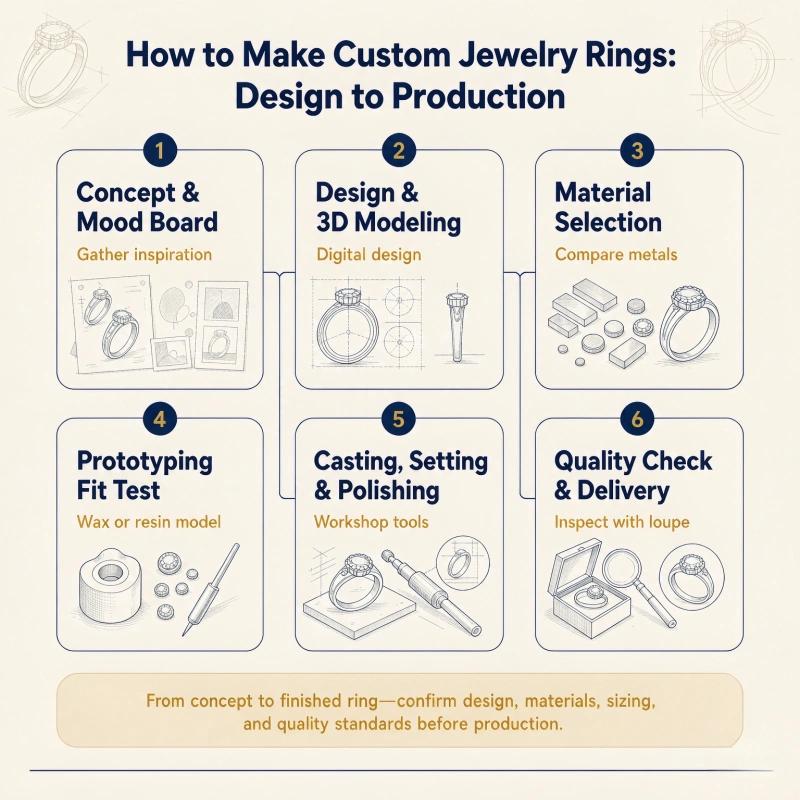
5. How Are Custom Jewelry Rings Made? The Manufacturing Process
The manufacturing method depends on the design and material.
Some fashion rings use casting and finishing. Others may use formed metal components, stamped parts, resin molding, or assembled decorative elements.
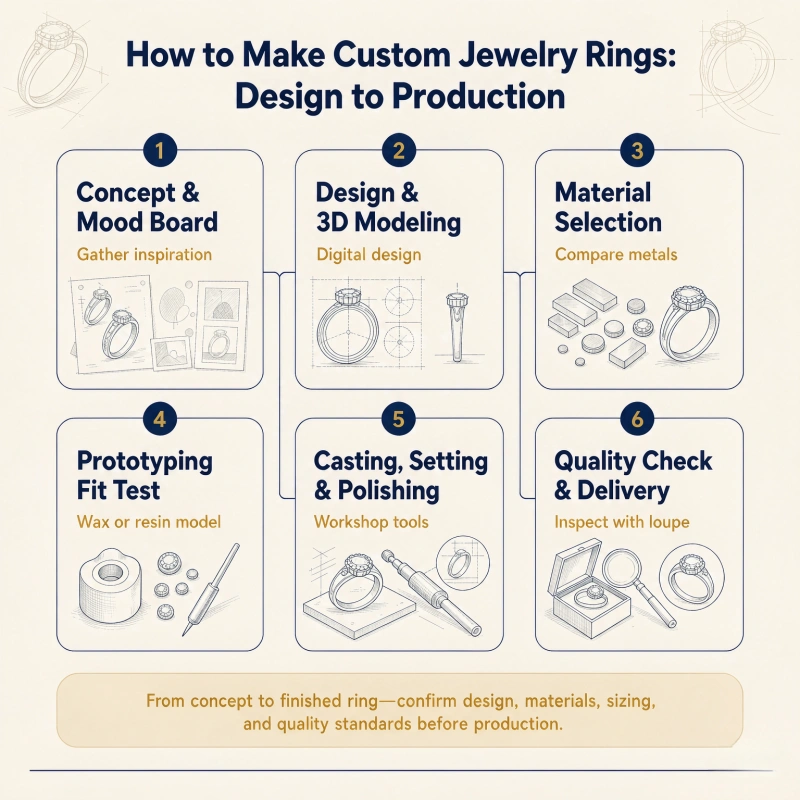
A typical custom ring development process includes the following stages.
Step 1: Prepare the Design Brief
Provide the manufacturer with your reference images, sketches, dimensions, target materials, surface finish, ring sizes, and estimated order quantity.
A clear brief should also identify the target selling market and whether the ring is intended for everyday fashion, gifting, or a seasonal collection.
Step 2: Design Development and Technical Review
The design team evaluates the proposed structure and identifies any potential manufacturing issues.
For example:
Is the band too thin for the intended structure?
Will the decorative top section remain balanced?
Is the ring opening suitable for the requested adjustment range?
Can the selected material achieve the required surface texture?
Is the stone or pearl attachment method suitable?
This stage is the best time to revise dimensions and construction details.
Step 3: CAD Drawing or Model Development
For designs requiring precise shapes or casting, the manufacturer may create a CAD model.
CAD helps define:
Ring dimensions
Band profile
Decorative top section
Stone positions
Connection structures
Material thickness
For some simple stamped, formed, or assembled fashion rings, a measured drawing or physical prototype may be sufficient.
Do not assume that every custom fashion ring needs the same CAD and casting process.
Step 4: Mold or Prototype Development
Depending on the manufacturing method, the next step may involve mold making, wax or resin model printing, stamping tools, or a preliminary hand sample.
For cast-metal rings, a wax or castable resin model can be used before lost-wax casting.
For molded resin or acrylic rings, the tooling and color sample requirements will be different.
Charmwell's public company information describes in-house mold-making and casting capabilities, supporting the development of selected custom fashion jewelry components.
Step 5: Sample Production
The manufacturer creates a physical sample for review.
At this stage, check:
Ring size and inside diameter
Band width and thickness
Overall shape and proportions
Decorative element position
Surface texture and finish
Weight and wearing comfort
Edges and inner surface
Logo and packaging details
A rendering can show the appearance, but only a physical sample lets you evaluate the fit and actual construction.
Step 6: Production Approval
Once the sample is approved, record the final specifications.
Keep the following information:
Approved sample photographs
Material details
Ring dimensions
Size system and size assortment
Plating or coating color
Decorative component specifications
Packaging requirements
Any changes after approval should be documented before bulk production begins.
Step 7: Bulk Manufacturing
The factory arranges material purchasing, mold or tooling preparation, component manufacturing, assembly, surface finishing, and packaging.
For multi-piece ring sets, the factory must also confirm the correct number of pieces in each set and the required combination of colors, designs, or sizes.
Step 8: Quality Inspection and Packaging
Before shipment, inspect the finished products against the approved sample and specifications.
The specific checkpoints depend on the ring's structure and materials, but common checks include dimensions, finish consistency, surface defects, decorative component attachment, and packaging accuracy.
This final stage helps reduce avoidable issues when the rings reach retailers or end customers.
6. How Much Does It Cost to Make Custom Jewelry Rings?
There is no universal price for custom jewelry rings.
A simple gold-tone fashion ring and a multi-piece ring set with decorative stones involve different materials, production steps, and packaging requirements.
The most important cost factors include:
| Cost Factor | How It Affects the Price |
|---|---|
| Base material | Material type and consumption affect the cost |
| Ring dimensions | Larger or thicker structures may require more material |
| Design complexity | Complex shapes may require additional development and tooling |
| Decorative components | Pearls, stones, glass, acrylic, and resin add material and assembly costs |
| Surface finish | Plating, coating, polishing, and texturing affect production |
| Ring size assortment | Multiple sizes may require additional production planning |
| Order quantity | Quantity can influence production efficiency and unit cost |
| Packaging | Custom cards, pouches, boxes, and labels add costs |
Real Product Price References from Charmwell
The following are examples of prices and specifications currently published on Charmwell's ring product pages. They are reference listings, not guaranteed quotations for new custom designs.
| Published Product Example | Material | Listed Price | Published MOQ |
|---|---|---|---|
| Boho Burnished Pearl Ring | Zinc and acrylic | About US$0.50 | 200 |
| Fashion Pearl Ring Set | Zinc and acrylic | About US$0.65 | 200 |
| 5-Piece Gold-Plated Stackable Ring Set | Iron and zinc | About US$0.75 per set | 200 |
| Vintage Chunky Gold-Plated Ring Set | Zinc | About US$1.40 | 200 |
Prices can change with order quantity, material specifications, customization, and packaging. The examples should not be treated as equivalent products because their materials, structures, and set configurations are different.
How to Get an Accurate Custom Ring Quotation
To request a useful quotation, provide:
Design photograph, drawing, or reference SKU
Ring dimensions and size system
Base material and finish
Decorative component details
Quantity per design and size
Color variations
Logo and packaging requirements
Destination country and target delivery date
A well-defined quotation request helps manufacturers compare like-for-like specifications rather than giving you a price based on an incomplete picture.
7. How to Make Custom Ring Sets for Jewelry Brands
For fashion retailers, selling coordinated sets can be an effective way to introduce variety without developing completely unrelated products.
However, a successful ring set should be designed as a collection rather than assembled randomly.
7.1 Create a Consistent Design Theme
Choose a shared direction for the collection, such as:
Minimalist geometric shapes
Vintage hammered textures
Pearl-inspired elegance
Colorful summer designs
Nature-inspired details
Bold statement silhouettes
The rings can look different while maintaining a shared design language.
7.2 Decide the Number of Rings in Each Set
A product set might contain two, three, five, or more rings.
The ideal number depends on the retail price, target customer, and intended presentation.
For a multi-piece product, specify whether the rings are sold as one complete set or as separate units.
7.3 Confirm Size and Wearability
A collection with different ring widths or decorative tops should be reviewed for fit.
If the set includes adjustable rings, record their intended adjustment range. If it contains fixed-size rings, confirm every size and its quantity.
7.4 Coordinate the Packaging
A ring set can be presented in:
Individual jewelry bags
Ring cards
Multi-ring display cards
Gift boxes
Branded retail packaging
Packaging should protect the surfaces and decorative elements during shipping while presenting the products clearly to the customer.
8. How to Choose a Reliable Custom Ring Manufacturer
A suitable manufacturing partner should understand both the design and commercial requirements of your ring collection.
For brands and retailers, evaluate these points before confirming a supplier.
8.1 Check Relevant Ring Product Experience
Ask for examples of similar ring products.
A manufacturer experienced in metal ring sets may have different capabilities from a supplier specializing in resin or acrylic designs.
Review actual product photographs and ask which components can be customized.
8.2 Evaluate Sampling Capabilities
A supplier should be able to translate your design into a physical sample and help review construction details.
Ask how sample revisions are handled and which costs are included in the development quotation.
8.3 Confirm Material and Finishing Information
Request clear material specifications for the ring base, decorative elements, and surface treatment.
If your market has restricted-substance or chemical requirements, agree on the relevant testing standards and documentation before placing the production order.
Do not assume that a general statement such as nickel-free or compliant applies to every material and product variation.
8.4 Confirm MOQ by Design and Size
MOQ can vary depending on the ring structure, material, color, size assortment, tooling, and packaging.
A quotation should state whether the MOQ applies per design, per color, per size, or per complete set.
8.5 Review Quality Control Procedures
Ask how the manufacturer checks ring dimensions, surface appearance, decorative attachments, plating consistency, and final packaging.
For a repeat order, retain an approved sample and product specification sheet as the inspection reference.
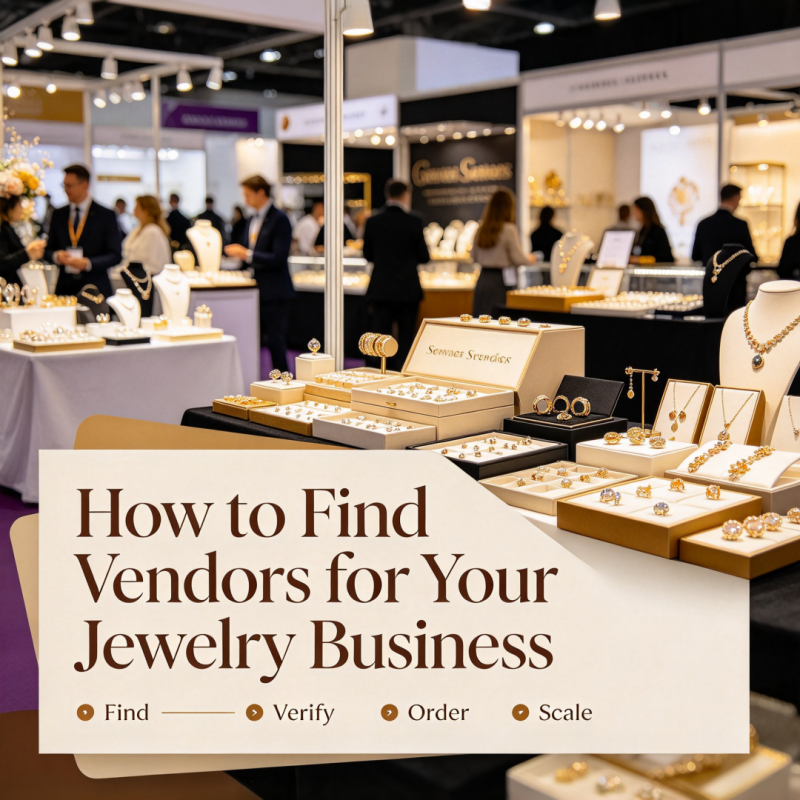
For more sourcing advice, read our guide on how to find vendors for your jewelry business.
9. Custom Jewelry Ring Manufacturing at Charmwell Accessories
Charmwell Accessories is the brand of Qingdao Charmwell Industry & Trading Co., Ltd., a China-based fashion jewelry manufacturer established in 2013.
The company provides OEM, ODM, and private-label jewelry solutions for international brands, retailers, wholesalers, and distributors.
Its ring collection includes minimalist bands, statement rings, pearl designs, decorative stone rings, resin styles, and multi-piece ring sets.
9.1 Ring Design and Customization
Depending on the design and manufacturing requirements, ring customization can include:
Ring shape and band profile
Decorative top section
Material and surface finish
Color and texture
Pearl, stone, glass, or acrylic details
Logo and branding
Jewelry cards and retail packaging
For example, a brand developing a vintage-inspired collection may combine a gold-tone finish, hammered surfaces, and decorative pearl details. Another brand may prefer colorful resin rings with gradient effects.
These approaches require different materials and production methods, so each design should be evaluated separately.
9.2 Sampling and Manufacturing Capacity
Charmwell's published company information includes:
Established in 2013
A dedicated sampling team of 10 makers
Approximately 1,000 samples developed per month
In-house mold-making and casting resources
Annual production capacity of approximately 5–7 million jewelry pieces
Standard production lead time of approximately 5–6 weeks from approval to shipment
100% shipment inspection reported by the company
These are company-level figures, not guaranteed timings or capacity allocations for every individual ring project. Actual sampling schedules and production quantities depend on the design and order requirements.
9.3 MOQ for Custom Rings
Several current Charmwell ring product listings show an MOQ of 200 pieces. The actual requirement for a new custom ring project should be confirmed based on the selected design, material, color, size assortment, and packaging.
For example, a simple ring set using an existing structure may have different development requirements from a ring requiring a new mold or multiple custom components.
9.4 Private Label Ring Packaging
For private-label brands, customization can extend beyond the ring itself.
Depending on your project, packaging options may include:
Branded ring cards
Logo labels
Jewelry pouches
Gift boxes
Product tags
Retail-ready packaging
Learn more about Charmwell's manufacturing background and capabilities on our About page.
10. Common Mistakes When Making Custom Jewelry Rings
Even a visually attractive design can encounter problems during production when important specifications are missing.
Mistake 1: Designing Only from a Front View
A ring should be reviewed from the top, side, and inside. A front-view photograph may not reveal the band thickness, setting height, or inner construction.
Better approach: Provide multiple reference views and confirm the important dimensions.
Mistake 2: Ignoring Ring Size Differences Between Markets
US, UK, and European sizing systems do not use the same numbers.
Better approach: State the required sizing system and provide the internal diameter or circumference where possible.
Mistake 3: Assuming Adjustable Rings Fit Everyone
Open rings still have structural limits.
Better approach: Confirm the intended adjustment range and make sure the sample can be adjusted without damaging the product.
Mistake 4: Choosing Decorative Stones Before Checking the Structure
A large or heavy decorative top may make a ring rotate or feel unbalanced.
Better approach: Review the component weight, base structure, and fit together during sample development.
Mistake 5: Changing Details After Sample Approval
Changes to the ring width, finish, material, or decorative components can affect production costs and lead time.
Better approach: Approve a written specification together with the physical sample.
Mistake 6: Comparing Quotations Without Comparing Specifications
Two rings may look similar in photographs but use different materials, dimensions, plating processes, or packaging.
Better approach: Compare quotations against the same design brief and order quantity.
11. Frequently Asked Questions About Custom Jewelry Rings
How do I start making a custom jewelry ring?
Start by choosing a ring style and preparing reference images or a sketch. Define the ring size, band dimensions, material, finish, decorative components, and intended quantity. A manufacturer can then evaluate the design and prepare a sample.
Can I make a custom ring from a photograph?
Yes. A photograph can be used as a starting point for custom development. However, you should provide additional dimensions, material preferences, and construction details before the sample is approved.
What materials are used for custom fashion rings?
Common fashion jewelry materials include zinc alloy, brass, iron, acrylic, resin, glass, and decorative pearl or stone components. The actual choice depends on the ring's shape, weight, finish, and target price.
Are custom rings always made with CAD and casting?
No. Some rings are developed through CAD modeling and casting, while others use stamping, metal forming, resin molding, hand assembly, or a combination of processes. The manufacturing route depends on the design and material.
How do I choose the correct ring size?
Use the sizing system required by your target market and confirm the internal diameter or circumference. A professional ring sizer or ring mandrel is more reliable than estimating size with paper or string.
What is the difference between a fixed-size ring and an adjustable ring?
A fixed-size ring is manufactured to a defined measurement. An adjustable ring has an open or flexible structure designed to accommodate a specified range of sizes. Adjustable rings should not be assumed to fit every wearer.
How much does a custom jewelry ring cost?
The price depends on materials, dimensions, design complexity, decorative components, tooling, finishing, order quantity, and packaging. The manufacturer needs a clear product specification to provide an accurate quotation.
What is the MOQ for custom fashion rings?
MOQ varies by product. Several Charmwell ring product listings currently show 200 pieces, but the actual MOQ for a custom project should be confirmed according to the design, size assortment, color, and packaging.
How long does it take to produce custom rings?
Charmwell reports a standard production lead time of approximately 5–6 weeks from approval to shipment. This is a company-level reference. Sampling, revisions, material availability, and order complexity may affect the actual schedule.
Can I create a private-label ring collection?
Yes. Depending on the manufacturing arrangement, you can customize ring designs, materials, colors, logos, jewelry cards, labels, and retail packaging.
Can I order different ring designs in one collection?
Yes. You can develop a coordinated collection with different shapes, textures, sizes, or decorative elements. Confirm the MOQ and production requirements for each design with the manufacturer.
Start Your Custom Jewelry Ring Project
Making custom jewelry rings requires a balance of design, materials, dimensions, manufacturing feasibility, and quality control.
For individual projects, the most important starting points are a clear design idea and accurate ring sizing. For jewelry brands and retailers, the process also requires a supplier who can develop samples, confirm specifications, manage size assortments, and support repeat production.
Charmwell Accessories supports custom fashion jewelry development, OEM manufacturing, ODM design, and private-label packaging for international jewelry businesses.
Whether you are developing stackable rings, minimalist bands, pearl rings, statement designs, or a coordinated ring collection, our team can discuss your product requirements and manufacturing options.
Ready to create your own custom jewelry rings?
Send us your reference images, preferred materials, ring dimensions, estimated order quantity, and packaging requirements.
Visit our Contact page to discuss your project and request a quotation.